What the FY2027 Maximum Allotment Means
The maximum allotment is the largest food stamp amount SNAP can pay a household in a month. USDA resets every figure on this page each October 1, and the current numbers run from October 1, 2026 through September 30, 2027.
A family of four in most of America can now reach $1,023 a month. That headline number hides a lot of geography, though, because five different tables govern one program.
This guide lists the maximum for every state by name, then breaks out the special tables for Alaska, Hawaii, Guam, and the Virgin Islands. Everything here comes straight from the USDA FY2027 cost-of-living adjustment, published on the official FNA COLA page.
Want the number you would actually get instead of the ceiling? Our free SNAP benefits calculator runs your income, deductions, and state rules in about two minutes.
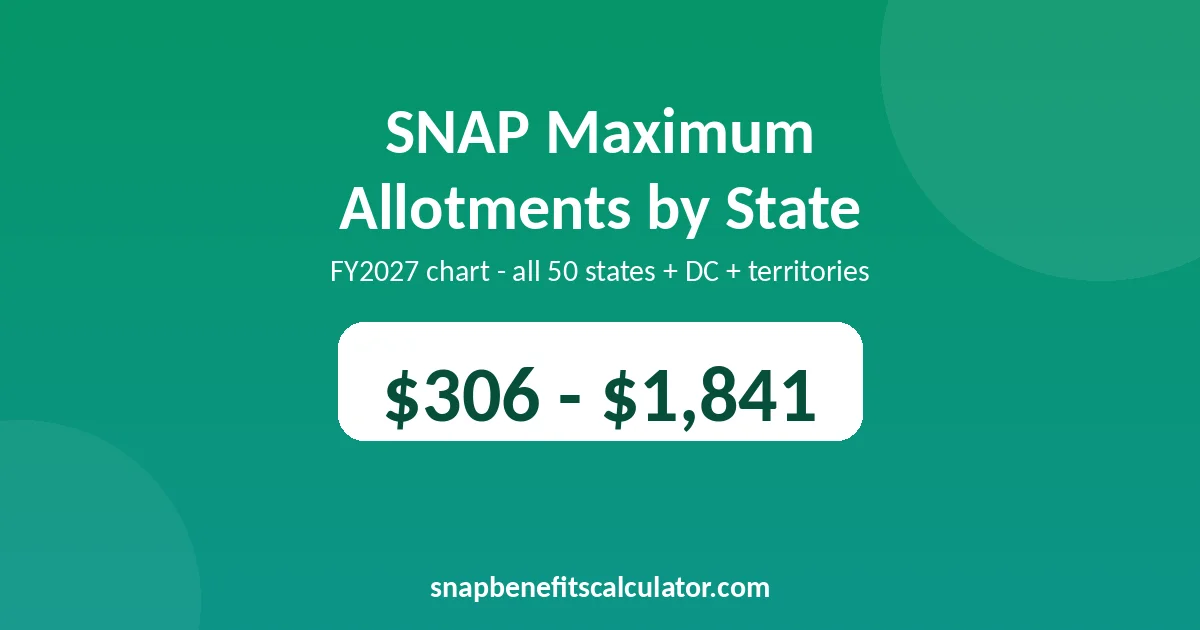
Every State, One Chart: FY2027 Maximum Allotments
Forty-eight states plus the District of Columbia share one table. Puerto Rico does not run SNAP, and the starred rows below follow their own tables, which appear in full further down.
Scan your state row for the maximum at household sizes one, four, and eight.
State | 1 person | 4 people | 8 people Advertisement
|
|---|---|---|---|
Alabama | $306 | $1,023 | $1,841 |
Alaska* | $392 | $1,306 | $2,352 |
Arizona | $306 | $1,023 | $1,841 |
Arkansas | $306 | $1,023 | $1,841 |
California | $306 | $1,023 | $1,841 |
Colorado | $306 | $1,023 | $1,841 |
Connecticut | $306 | $1,023 | $1,841 |
Delaware | $306 | $1,023 | $1,841 |
District of Columbia | $306 | $1,023 | $1,841 |
Florida | $306 | $1,023 | $1,841 |
Georgia | $306 | $1,023 | $1,841 |
Hawaii* | $496 | $1,655 | $2,979 |
Idaho | $306 | $1,023 | $1,841 |
Illinois | $306 | $1,023 | $1,841 |
Indiana | $306 | $1,023 | $1,841 |
Iowa | $306 | $1,023 | $1,841 |
Kansas | $306 | $1,023 | $1,841 |
Kentucky | $306 | $1,023 | $1,841 |
Louisiana | $306 | $1,023 | $1,841 |
Maine | $306 | $1,023 | $1,841 |
Maryland | $306 | $1,023 | $1,841 |
Massachusetts | $306 | $1,023 | $1,841 |
Michigan | $306 | $1,023 | $1,841 |
Minnesota | $306 | $1,023 | $1,841 |
Mississippi | $306 | $1,023 | $1,841 |
Missouri | $306 | $1,023 | $1,841 |
Montana | $306 | $1,023 | $1,841 |
Nebraska | $306 | $1,023 | $1,841 |
Nevada | $306 | $1,023 | $1,841 |
New Hampshire | $306 | $1,023 | $1,841 |
New Jersey | $306 | $1,023 | $1,841 |
New Mexico | $306 | $1,023 | $1,841 |
New York | $306 | $1,023 | $1,841 |
North Carolina | $306 | $1,023 | $1,841 |
North Dakota | $306 | $1,023 | $1,841 |
Ohio | $306 | $1,023 | $1,841 |
Oklahoma | $306 | $1,023 | $1,841 |
Oregon | $306 | $1,023 | $1,841 |
Pennsylvania | $306 | $1,023 | $1,841 |
Rhode Island | $306 | $1,023 | $1,841 |
South Carolina | $306 | $1,023 | $1,841 |
South Dakota | $306 | $1,023 | $1,841 |
Tennessee | $306 | $1,023 | $1,841 |
Texas | $306 | $1,023 | $1,841 |
Utah | $306 | $1,023 | $1,841 |
Vermont | $306 | $1,023 | $1,841 |
Virginia | $306 | $1,023 | $1,841 |
Washington | $306 | $1,023 | $1,841 |
West Virginia | $306 | $1,023 | $1,841 |
Wisconsin | $306 | $1,023 | $1,841 |
Wyoming | $306 | $1,023 | $1,841 |
Guam | $452 | $1,507 | $2,714 |
U.S. Virgin Islands | $394 | $1,315 | $2,367 |
*Alaska and Hawaii figures shown are the Urban Alaska and standard Hawaii values. Both states carry zone or timing rules that the dedicated sections below explain.
Notice how 48 rows repeat the same three numbers. Only geography outside the contiguous bloc, plus DC exceptions in food costs, ever moves the figure.
The Contiguous-US Table by Household Size
Here is the full FY2027 ladder for the 48 states and DC, including two brand-new rows for very large households.
Household size | Maximum monthly benefit |
|---|---|
1 | $306 |
2 | $562 |
3 | $808 |
4 | $1,023 |
5 | $1,217 |
6 | $1,463 |
7 | $1,616 |
8 | $1,841 |
Each extra (9-17) | +$225 |
18 or more | $3,887 cap |
Two structural changes arrived this year. Households of nine through seventeen people add a flat $225 per extra member, and households of eighteen or more stop climbing at $3,887.
That $3,887 ceiling is the first hard cap in modern SNAP history, created by the 2025 federal benefits law. A twenty-person household that once projected past $4,400 now stops at the cap.
Alaska: Three Zones, Three Tables
Alaska prices food differently in its cities, its road-connected bush, and its fly-in villages. Your ZIP code decides which column applies.
Household size | Urban | Rural 1 | Rural 2 |
|---|---|---|---|
1 | $392 | $499 | $608 |
2 | $718 | $916 | $1,115 |
3 | $1,032 | $1,316 | $1,602 |
4 | $1,306 | $1,666 | $2,027 |
5 | $1,555 | $1,982 | $2,413 |
6 | $1,868 | $2,382 | $2,900 |
7 | $2,064 | $2,632 | $3,204 |
8 | $2,352 | $2,999 | $3,650 |
Each extra (9-17) | +$287 | +$366 | +$446 |
18+ households | $4,965 | $6,331 | $7,705 |
Minimum (1-2 people) | $31 | $40 | $49 |
Rural 2 covers the most remote areas such as Nome census areas and villages off the road system. Groceries flown in by small plane cost far more, so the maximum runs almost double Urban Alaska.
The minimum benefit climbs with remoteness too. An eligible one or two-person household gets $31 in Anchorage but $49 in Rural 2 zones.
Our Alaska SNAP calculator picks the right zone automatically once you enter your region.
Hawaii: The One State Where Maximums Fell
Hawaii is the exception to the October raise. Every maximum on the island chain dropped this year, and the state's own DHS notice explains why.
Household size | FY2027 | FY2026 |
|---|---|---|
1 | $496 | $506 |
2 | $910 | $942 |
3 | $1,307 | $1,349 |
4 | $1,655 | $1,689 |
5 | $1,969 | $2,033 |
6 | $2,367 | $2,437 |
7 | $2,615 | $2,701 |
8 | $2,979 | $3,040 |
Each extra (9-17) | +$364 | +$371 |
USDA's regional food cost study found Hawaii's Thrifty Food Plan had been measured too high. Federal law now walks the state's benefits down in steps through FFY 2029.
The average household loses about $8.55 per person this year. A family of four dropped $34, from $1,689 to $1,655 a month.
Reporting expenses softens the cut. Rent, utilities, childcare, and out-of-pocket medical costs for seniors all raise your deduction total, which our Hawaii SNAP guide walks through.
Guam and the Virgin Islands
Two island territories run SNAP with their own price tables. Both max out well below Hawaii but well above the 48-state figures at the small end.
Household size | Guam | Virgin Islands |
|---|---|---|
1 | $452 | $394 |
2 | $829 | $723 |
3 | $1,191 | $1,039 |
4 | $1,507 | $1,315 |
5 | $1,794 | $1,565 |
6 | $2,156 | $1,880 |
7 | $2,382 | $2,078 |
8 | $2,714 | $2,367 |
Each extra (9-17) | +$331 | +$289 |
18+ households | $5,729 | $4,997 |
Minimum (1-2 people) | $36 | $32 |
Guam's $452 opening maximum is the highest one-person figure outside Alaska. The Virgin Islands sit closer to the mainland numbers because most groceries arrive by container ship.
Why You Almost Never Receive the Full Maximum
The table is a ceiling, not a promise. SNAP expects your household to spend about 30 percent of its own net income on food, and the benefit covers the rest of the gap.
A four-person household with $800 in counted net income gets roughly $1,023 minus $240, or about $783. Only zero-income households receive the full table amount.
Deductions decide how close you land to the ceiling. The standard deduction now takes $217 off for households of one to three, and shelter costs above half your income can deduct up to $769 more.
Roughly $187 was the average benefit per person in mid-2026, far under any maximum on this page. That gap is normal, not a mistake.
What Changed From FY2026 to FY2027
October 1 moved almost every number upward. The four-person maximum rose $29 to $1,023, and the one-person floor for full benefits climbed from $298 to $306.
The minimum benefit for eligible one and two-person households ticked up a dollar to $25 in the 48 states. Hawaii's minimum moved the other way, dropping from $41 to $40.
The two large-household rules are entirely new this year. Nothing like the $3,887 ceiling existed before FY2027, so older articles across the web now overstate very large household benefits.
Deductions rose too. The shelter cap moved to $769, the homeless shelter deduction hit $205.66, and the asset limit for seniors and disabled members reached $4,750.
Using This Chart With Your Own Numbers
Find your state, match your household size, and you have the ceiling. Your real amount depends on net income, which deductions shrink.
The fastest route to your own figure is the SNAP benefits calculator at the top of this page. It applies your state's exact table, the 30 percent offset, and every deduction automatically.
Pair the maximum with the income side too. Our companion guide covers SNAP income limits for every state, including which states screen at 200 percent of poverty instead of 130.
Once benefits land, timing matters as well. The EBT deposit schedule shows when each state loads monthly funds onto cards.
Worked Examples: From the Ceiling Down to Your Check
Charts become clearer with real math. These three examples use the FY2027 tables and the 30 percent offset rule together.
Start with a Georgia family of three earning nothing countable. Their ceiling is $808, so their first month's benefit equals the full maximum.
Add $900 in monthly net income to that same family and the math shifts. Thirty percent of $900 is $270, so the check lands at $808 minus $270, or $538.
Now take a retired couple in Rural 2 Alaska. Their two-person ceiling is $1,115, and $600 of net income trims the benefit by $180, leaving $935.
A Honolulu senior living alone shows the Hawaii side. The one-person maximum is $496, and $1,200 in net income cuts the benefit to $136 after the $360 offset.
Notice every example stops well short of the table. Deductions are the only lever that pushes your net income, and therefore your check, back toward the ceiling.
Reading the $225 Ladder Correctly
Large households misread the new add-on more than anything else on this page. The rule adds $225 per person only for members nine through seventeen.
A ten-person household in the 48 states gets $1,841 for the first eight people. Two extra members add $450, bringing the total to $2,291.
A twelve-person household reaches $2,741, and a seventeen-person household tops the ladder at $3,866. At eighteen, the count stops and the flat $3,887 cap takes over.
Alaska and the territories run their own ladders with the same structure. Rural 1 Alaska, for instance, adds $366 per member between nine and seventeen before its own eighteen-plus ceiling of $6,331.
Foster children and most exchanged-care arrangements count toward household size. Roommates who buy and prepare food separately do not, even when they share a kitchen.
Your First Month Is Usually Prorated
Benefits start the day you apply, not the day you are approved. If that day falls late in the month, the first payment shrinks to match.
Apply on the twentieth of a 30-day month and you receive one third of a full month, prorated by remaining days. The second month pays at the full chart amount.
Expedited service skips the wait for households with almost no income or resources. States must issue those first payments within seven days.
SNAP Maximum Allotments by State: FAQ
What is the maximum SNAP benefit for a family of four in FY2027?
A family of four reaches $1,023 a month in the 48 contiguous states and DC. The same family tops out at $1,306 to $2,027 across Alaska's three zones, $1,655 in Hawaii, $1,507 in Guam, and $1,315 in the Virgin Islands.
Which state pays the highest SNAP maximum?
Rural 2 Alaska pays the highest amounts in the country. Its eight-person ceiling of $3,650 and one-person figure of $608 both lead every other jurisdiction.
Why did Hawaii SNAP benefits decrease in October 2026?
USDA's regional food cost study measured Hawaii's Thrifty Food Plan lower than the 2021 national update assumed. Federal adjustment steps now reduce the state's tables annually through FFY 2029.
Do all 48 states pay the same maximum SNAP amount?
Yes. Every contiguous state plus DC uses one federal table, so the FY2027 four-person maximum is $1,023 whether you live in Texas, New York, or Wyoming.
How much can a household of 20 receive in FY2027?
In the 48 states and DC, an eighteen-plus household caps at $3,887 per month. Alaska's equivalent ceilings run from $4,965 to $7,705 depending on zone, and Hawaii's cap sits at $6,289.
What is the minimum SNAP benefit in FY2027?
Eligible one and two-person households get at least $25 in the 48 states and DC. Guam pays a $36 floor, Hawaii $40, the Virgin Islands $32, and Alaska between $31 and $49 by zone.
Do maximum allotments change during the year?
No. Figures hold for the full federal fiscal year and reset every October 1. Mid-year changes only happen through special legislation, as happened with the 2025 benefits law's household cap.