How SNAP Income Limits Actually Work
Every SNAP application passes through income screens, and the screen your household faces depends on where you live. Federal law sets a 130 percent of poverty baseline, but most states raise it through a rule called broad-based categorical eligibility.
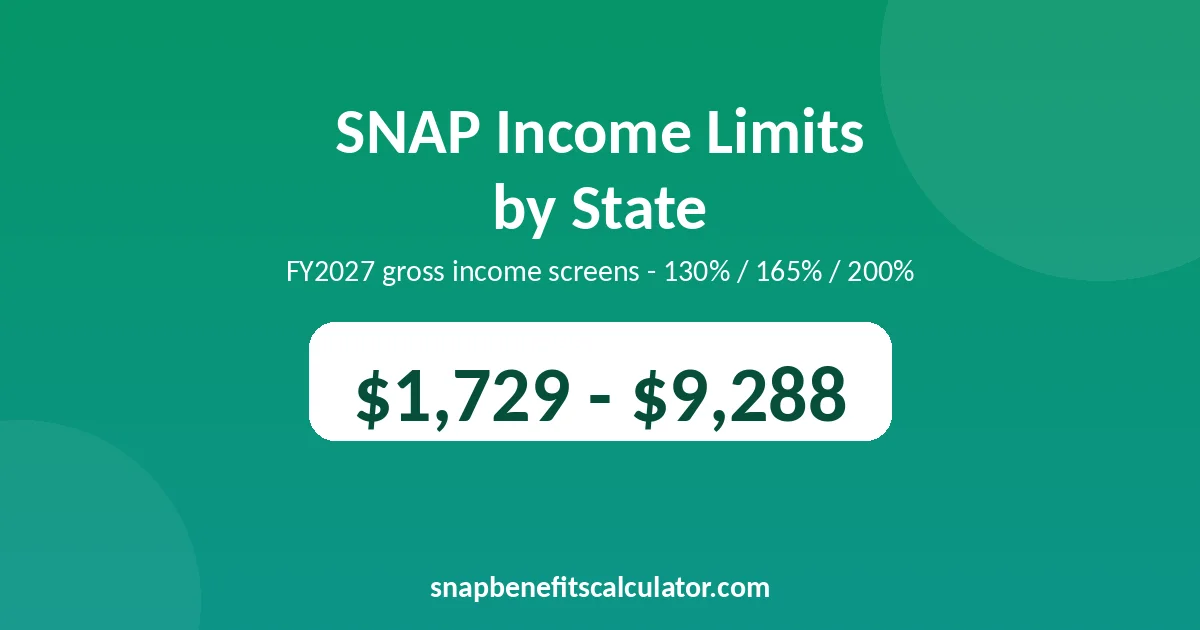
This guide lists the FY2027 gross income limit for every state and territory in one chart. It runs from October 1, 2026 through September 30, 2027, using USDA's official FY2027 standards.
Income limits only decide entry. Your actual benefit comes from the benefit formula, which our SNAP benefits calculator estimates in about two minutes.
The 130 Percent Federal Baseline
Households without special conditions start here. Gross income means everything coming in before deductions, from wages to Social Security to child support.
Household size | Monthly gross limit |
|---|---|
1 | $1,729 |
2 | $2,345 Advertisement
|
3 | $2,960 |
4 | $3,575 |
5 | $4,191 |
6 | $4,806 |
7 | $5,421 |
8 | $6,037 |
Each extra member | +$616 |
Seven states still use this 130 percent screen for everybody, and several others apply it to households that miss their state's wider door. The baseline never disappears entirely.
What 200 Percent BBCE Does to the Limit
Broad-based categorical eligibility lets states confer SNAP eligibility through TANF-funded benefits. States pick their own gross income ceiling under the rule, and twenty-nine jurisdictions have raised it all the way to 200 percent of poverty.
Household size | Monthly gross limit |
|---|---|
1 | $2,660 |
2 | $3,608 |
3 | $4,554 |
4 | $5,500 |
5 | $6,448 |
6 | $7,394 |
7 | $8,340 |
8 | $9,288 |
Each extra member | +$948 |
The practical effect is huge for working families. A three-person household in Michigan can earn up to $4,554 gross each month and still pass the income screen, while the same family in Mississippi stops at $2,960.
Higher gross limits do not guarantee benefits. Every 200 percent household must still pass the net income test after deductions, which is where rent, utilities, and childcare costs fight back.
The 165 Percent Table for Elderly and Disabled Households
Households containing a member aged 60 or older, or a disabled member, get their own federal screen at 165 percent of poverty. Several states also borrow this level as their BBCE ceiling for everyone.
Household size | Monthly gross limit |
|---|---|
1 | $2,195 |
2 | $2,976 |
3 | $3,757 |
4 | $4,538 |
5 | $5,319 |
6 | $6,100 |
7 | $6,881 |
8 | $7,662 |
Each extra member | +$781 |
Texas, Illinois, Nebraska, Guam, and Arkansas's elderly or disabled caseload all screen at 165 percent. Alaska's adjusted standards sit higher still because of its food-cost zones.
Every State's Gross Income Screen in One Table
This is the chart to bookmark. Each row shows the gross income screen your state applies and whether savings are counted.
Percentages refer to the federal poverty level, so a 200 percent state uses the second table above and a 165 percent state uses the third.
Jurisdiction | Gross income screen | Asset rule |
|---|---|---|
Alabama | 130% | No asset test |
Alaska | 200% (AK-adjusted) | No asset test |
Arizona | 200% | No asset test |
Arkansas | 165% elderly/disabled; 130% others | $5,500 for 12 months (one-time) |
California | 200% | No asset test |
Colorado | 200% | No asset test |
Connecticut | 200% | No asset test |
Delaware | 200% | No asset test |
District of Columbia | 200% | No asset test |
Florida | 200% | No asset test |
Georgia | 130% | No asset test |
Guam | 165% | No asset test |
Hawaii | 200% | No asset test |
Idaho | 130% | $5,000 |
Illinois | 165% | No asset test |
Indiana | 130% | $5,000 |
Iowa | 160% | No asset test |
Kentucky | 200% | No asset test |
Louisiana | 200% | No asset test |
Maine | 200% | No asset test |
Maryland | 200% | No asset test |
Massachusetts | 200% | No asset test |
Michigan | 200% | No asset test |
Minnesota | 200% | No asset test |
Montana | 200% | No asset test |
Nebraska | 165% | $25,000 liquid |
Nevada | 200% | No asset test |
New Hampshire | 200% | No asset test |
New Jersey | 185% | No asset test |
New Mexico | 200% | No asset test |
New York | 200% with dependent care; 150% with earned income | No asset test |
North Carolina | 200% | No asset test |
North Dakota | 200% | No asset test |
Ohio | 130% | No asset test |
Oklahoma | 130% | No asset test |
Oregon | 200% | No asset test |
Pennsylvania | 200% | No asset test |
Rhode Island | 185% | No asset test |
South Carolina | 130% | No asset test |
Texas | 165% | $5,000 (one vehicle to $22,000 excluded) |
Utah | 130% (no BBCE) | $3,000 / $4,750 |
Vermont | 185% | No asset test |
Virgin Islands | 175% | No asset test |
Virginia | 200% | No asset test |
Washington | 200% | No asset test |
West Virginia | 200% | No asset test |
Wisconsin | 200% | No asset test |
Wyoming | 130% (no BBCE) | $3,000 / $4,750 |
Utah and Wyoming appear with the 130 percent baseline because they have not adopted BBCE. Kansas, Missouri, Mississippi, South Dakota, and Tennessee complete the seven-state group without the option.
The Seven States Without BBCE
Kansas, Missouri, Mississippi, South Dakota, Tennessee, Utah, and Wyoming stick to regular federal rules. Gross income must stay under 130 percent of poverty for every household, including those with seniors.
Savings count in these states too. Countable resources must sit below $3,000, or below $4,750 when a member is 60 or older or disabled.
Households receiving SSI or TANF cash still qualify categorically in these states. The BBCE gap only affects families that rely on earned income alone.
Gross Versus Net: Where Deductions Save Applications
Passing the gross screen only gets you to the net test. Net income equals gross income minus deductions, and it must fall below 100 percent of poverty.
Household size | Monthly gross limit |
|---|---|
1 | $1,330 |
2 | $1,804 |
3 | $2,277 |
4 | $2,750 |
5 | $3,224 |
6 | $3,697 |
7 | $4,170 |
8 | $4,644 |
Each extra member | +$474 |
Three deductions do most of the work. The standard deduction removes $217 for households of one to three, excess shelter costs deduct above half of adjusted income up to a $769 cap, and childcare needed for work deducts dollar for dollar.
Households with a senior or disabled member also deduct out-of-pocket medical costs above $35 each month. A $400 monthly prescription bill becomes a $365 deduction.
Worked Examples From Two States
Numbers land better with faces. Consider a Texas family of three earning $3,400 gross each month from one job.
Texas screens at 165 percent, so the family's limit is $3,757 and they pass the gross test. Rent and utility deductions drop their net income to about $2,100, which sits under the $2,277 net limit for three, so benefits flow.
Now a California family of three with $4,100 gross. Their 200 percent screen allows up to $4,554, so they enter the net test with room to spare and qualify after standard and shelter deductions.
Move that same California family to Mississippi and the story flips. Their $4,100 gross fails the $2,960 screen immediately, no matter how high their rent runs.
What Counts as Income, and What Doesn't
Gross income covers more than a paycheck. Wages, self-employment profit, Social Security, unemployment checks, child support received, and rental income all count toward the screen.
Self-employed applicants subtract allowable business expenses first. A rideshare driver reports profit after gas and maintenance, not the raw fare total.
Several common receipts never count. Tax refunds, child tax credit payments, education grants and loans, and most catastrophe assistance stay off the ledger entirely.
Income timing trips people up too. States annualize irregular earnings, so a seasonal worker's limit check uses an average month rather than the best or worst one.
The 2025 Law's Eligibility Changes Still Rolling Out
The One Big Beautiful Bill Act rewired parts of SNAP eligibility alongside the $3,887 benefit ceiling explained in our maximum allotments by state guide. Two changes matter most at the income screen.
Work requirements now run from age 18 through 64, up from 49, and demand 80 hours of work or training each month. Parents with children aged 14 and older lost their previous exemption.
Non-citizen rules narrowed as well. Asylum seekers, refugees, and parolees who could formerly qualify lost eligibility, while lawful permanent residents, Cuban-Haitian entrants, and COFA nationals kept their path.
States began enforcing the work rules in November 2025, and the veteran and homelessness exemptions ended at the same time. Check our SNAP eligibility guide for the full rule stack.
Special Households: Students, Seniors, and Mixed Cases
College students face an extra gate beyond income. Enrollment half-time or more requires an exemption such as a work-study award, 20 weekly work hours, or a dependent under six, though several states broaden this through their own TANF-funded rules.
Households with a member who is 60 or older or disabled play by softer rules everywhere. They skip the gross screen entirely under regular federal rules, and medical costs above $35 become deductible.
Mixed-status households count only the eligible members' incomes in most cases. A household with one ineligible non-citizen still prorates the benefit rather than closing the case.
Boarders and roommates split differently. Paying boarders are not household members, while a spouse almost always is, regardless of who buys the groceries.
Proving Your Numbers at the Interview
The screen only matters if your paperwork backs it. Pay stubs covering the last 30 days, a benefits award letter, or an employer statement usually satisfies the earned income test.
Self-employed applicants bring profit-and-loss records or the most recent tax return. States average the figures across the year rather than taking your best month.
Rent receipts, utility bills, and childcare invoices unlock the deductions that lower net income. Missing paperwork rarely causes denial outright, but it delays benefits until the county office verifies what you owe.
When Your Income Changes Mid-Year
Approval locks your limit check at one moment, but income rarely stands still. Most states now use simplified reporting, where you flag big changes at your six-month review rather than weekly.
Two events break that rule almost everywhere. Income crossing your state's gross screen and lottery or gambling wins over the reporting threshold must be reported within ten days in many states.
A raise that pushes you over the line does not always end benefits immediately. States recalculate with deductions first, and some phase amounts down rather than cutting the case entirely.
SNAP Income Limits by State: FAQ
What is the income limit for food stamps in FY2027?
The federal baseline is 130 percent of poverty, which starts at $1,729 a month for one person. Most states raise the gross screen to 200 percent through BBCE, where a one-person household can earn up to $2,660.
Which states use the 200 percent income limit for SNAP?
Twenty-nine jurisdictions screen at 200 percent, including California, Michigan, Arizona, Washington, Florida, and Pennsylvania. Alaska uses an adjusted 200 percent table for its higher-cost zones.
Can I get SNAP if I make $20 an hour?
Full-time work at $20 an hour grosses about $3,460 a month. A single person fails the screen in every state except the 200 percent group, while a three-person household passes the gross test in all but the 130 percent states.
Does SNAP check my bank account?
States without BBCE count savings against $3,000 or $4,750 limits. BBCE states waive the asset test for most households, though Texas, Idaho, Indiana, Nebraska, and Arkansas keep their own caps.
Why do income limits change every October?
USDA rewrites the poverty-based tables each October 1 using the prior year's poverty guidelines. FY2027 limits use the 2026 guidelines, which lifted the one-person gross baseline from $1,696 to $1,729.
Do I apply the gross limit or the net limit to my family?
Both, in order. Gross income clears your state's screen first, then deductions bring net income under the 100 percent table to set the benefit amount.
Where can I check my own household quickly?
Run your numbers through the free food stamp calculator on this site. It applies your state's exact screen, the full deduction stack, and your EBT deposit timing automatically.