"I make too much for food stamps." In Maryland, that sentence is wrong more often than anywhere else in America.
Maryland screens most households at 200 percent of the federal poverty level — roughly double the income ceiling of the states around it — and it dropped the asset test entirely, so your savings account has nothing to do with eligibility.
A family of three in Baltimore earning $4,200 a month, which would fail the income screen in Missouri or Texas, still qualifies for a Maryland SNAP calculation.
A Maryland food stamp calculator turns that generous screen into a dollar figure you can actually plan groceries around.
You feed it your household size, your paychecks, and your rent; it applies the same sequence a Maryland Department of Human Services caseworker applies, in the same order, using the FY2027 standards that took effect October 1, 2026. The whole run takes about two minutes.
This guide walks the full chain: the 200 percent income table, the no-asset-test rule, the deductions that decide how much you actually get, two worked examples with the math shown line by line, and the Independence Card deposit schedule that runs from the 4th to the 23rd.
Every figure uses FY2027 standards, current through September 30, 2027.
A Maryland SNAP calculator applies the 200% gross income screen, the standard and shelter deductions, and the FY2027 benefit formula to your household numbers.
A three-person household in Baltimore earning $3,600 in gross monthly wages with a $1,600 rent lands near $90 a month on the Independence Card, against an $808 maximum for that household size — proof that eligibility and benefit size are two very different questions.
| Maryland SNAP Fact | FY2027 Detail |
|---|---|
| Administering agency | Maryland Department of Human Services (DHS), through local departments of social services |
| Gross income limit (most households) | 200% FPL — $2,660 single / $5,500 family of four |
| Asset test | None — savings, vehicles, and bank balances are not counted |
| Max monthly benefit (FY2027) | $306 – $1,841 (+$225 per additional member) |
| EBT card | Maryland Independence Card; deposits 4th–23rd by the first three letters of your last name |
| Where to apply | myMDTHINK portal, by phone, or at your local department of social services |
The 200% Screen That Makes Maryland Different
Most of the country runs SNAP eligibility through a 130 percent of poverty gross income test. Maryland uses broad-based categorical eligibility to lift that screen to 200 percent, and the difference is not cosmetic — it decides who gets in the door at all.
Under the federal baseline, a family of three stops qualifying at $2,960 in gross monthly income. Under Maryland's rule, the same family keeps qualifying until $4,554.
A nurse's aide in Prince George's County working full-time at $21 an hour earns about $3,640 a month, clears the Maryland screen with room to spare, and fails the federal one by nearly $700.
The wider screen does not change the benefit formula itself. Every household that enters still faces the 100 percent FPL net income test for the actual calculation, and the deductions do exactly the same work they do everywhere else.
The 200 percent rule simply means that working households with heavy shelter costs — which is most of Maryland's wage-earning applicants — get the chance to run the math at all.
In the states around Maryland, many of those households never reach the deduction stage because the gross screen ends the case first.
One caution belongs here: a wide door is not the same as a big check. The calculator will tell you the truth about both.
Eligibility at 200 percent often produces a small benefit — single digits are not rare for working households — while eligibility at 130 percent or below tends to produce meaningful ones. Both outcomes matter, and both start with the same screen.
Maryland Income Limits for FY2027
These are the FY2027 gross income limits for Maryland households, effective October 1, 2026:
| Household size | Gross income limit (200% FPL) | Max monthly benefit |
|---|---|---|
| 1 person | $2,660 | $306 |
| 2 people | $3,608 | $562 |
| 3 people | $4,554 | $808 |
| 4 people | $5,500 | $1,023 |
| Each additional person | +$946 | +$225 |
Gross income counts everything that arrives in the month before anything is subtracted: wages before taxes, self-employment receipts before business costs, Social Security at the award-letter figure, child support that actually arrives, unemployment insurance, and retirement distributions.
The twenty percent earned income deduction is the only thing Maryland lets you shave before the screen, which is why a $3,600 paycheck counts as $2,880 when the caseworker runs the test.
Households that clear the 200 percent screen face the net income limit — 100 percent of poverty, $1,330 for one person and $2,750 for four in FY2027 — where the deductions finally enter the picture.
California runs a similar 200 percent screen for CalFresh, and the California income limits guide shows the parallel; for the full national picture, the FY2027 income limits by state chart lines every state's screen up side by side.
No Asset Test in Maryland
The second Maryland difference is the one that quietly wins cases: there is no resource test. Checking balances, savings accounts, retirement funds, and the value of vehicles simply do not come up in a Maryland SNAP application.
A household with $15,000 in the bank and $3,000 in monthly income can qualify in Maryland on income alone, while the same household would be denied outright in states that still count resources.
That rule matters most for two groups. Working families building an emergency fund can save without watching eligibility evaporate — the poverty trap where saving money disqualifies you from help does not exist here.
And fixed-income seniors can keep a lifetime of modest savings while still qualifying for the senior deductions that make small Social Security checks stretch. In both cases the entire eligibility question collapses down to the income math, which is exactly what the calculator models.
The no-asset rule also simplifies the application itself. Maryland does not ask for bank statements to test resources, so the document stack is shorter: identity, income, shelter costs, and whatever deductions you plan to claim.
The Deductions That Move a Maryland Estimate
Once a Maryland household clears the 200 percent screen, five deductions decide where between $25 and $1,841 the monthly benefit lands.
The standard deduction comes off first: $217 a month for households of one to three, $229 for four, $268 for five, $308 for six or more in FY2027.
The excess shelter deduction is the workhorse in a state with Maryland's rents: housing costs above half of adjusted income become deductible, capped at $769 a month for households without a senior or disabled member.
A Baltimore renter paying $1,600 with heat included reaches that cap without trying, and every dollar of it improves the benefit.
Households paying heating or cooling separately stack Maryland's utility allowance on top, and that line item routinely moves working-family benefits by $100 or more.
The earned income deduction removes twenty percent of gross wages automatically.
Childcare costs that let a parent work are deductible with no dollar cap — in a state where infant care runs well over $1,000 a month, this deduction can be the difference between a token benefit and a real one.
And households with a member 60 or older or disabled deduct out-of-pocket medical expenses above $35 a month, including Medicare premiums, prescription copays, and transportation to treatment.
The benefit calculation guide walks the full sequence, and the SNAP benefits calculator runs it against your own numbers in the caseworker's order.
Two Maryland Estimates, Worked Start to Finish
Example 1: Baltimore family of three
A warehouse worker and part-time cook together earn $3,600 a month gross and pay $1,600 rent with heat included. Under the federal 130 percent screen they would already be denied — $3,600 is $640 over the $2,960 ceiling for three.
Maryland's 200 percent screen clears them easily: $3,600 counts as $2,880 after the earned income deduction, under the $4,554 limit. The $217 standard deduction brings them to $2,663.
Their shelter deduction is $1,600 rent minus half of $2,663 ($1,331.50), which leaves $268.50. Net income lands at $2,394.50, thirty percent of that is $718.35, and the benefit is the $808 maximum minus that figure: $90 a month.
Small, real, and worth claiming — $90 a month is $1,080 of groceries a year that did not exist before the application.
Example 2: Columbia senior on Social Security
A 72-year-old widower receives $1,100 a month in Social Security, pays $900 rent in a Columbia senior apartment, and has $185 withheld for Medicare Part B.
He clears the 200 percent screen at any income he could realistically have, and Maryland applies no asset test to his savings. Social Security is unearned, so no earned income deduction applies.
The standard deduction brings him to $883, the medical deduction removes $150 of Medicare premium above the $35 threshold, and he lands at $733.
His shelter excess is $900 minus $366.50, or $533.50 — well under the $769 cap, and the cap does not apply to him anyway because his household includes a senior. Net income is $199.50, so his benefit is $306 minus $59.85: $247 a month.
Independence Card Deposit Dates
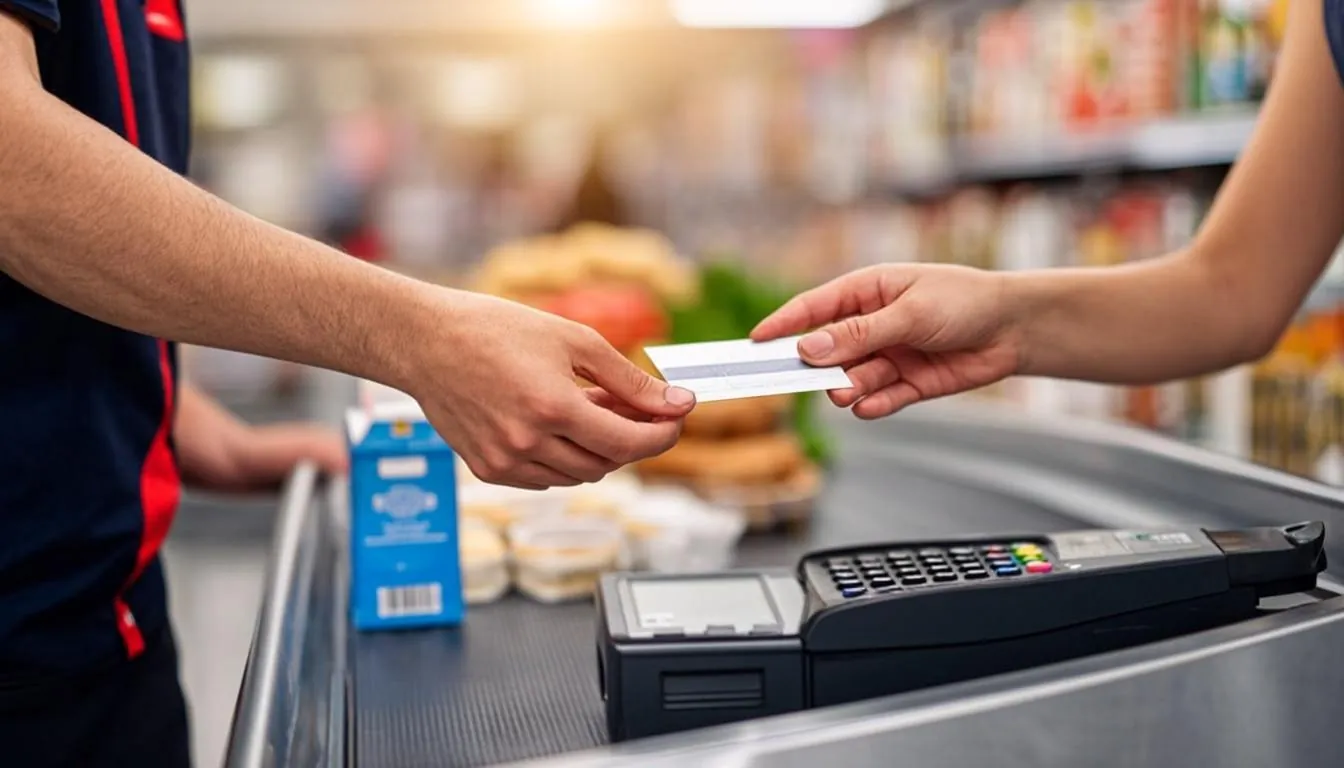
Maryland loads SNAP benefits between the 4th and the 23rd of each month, and your exact day is fixed by the first three letters of your last name — not by your case number, and not by your birthday.
The schedule below is the official DHS chart:
| First 3 letters of last name | Deposit day |
|---|---|
| AAA – BAO | 4th of the month |
| BAP – BQZ | 5th |
| BRA – CAQ | 6th |
| CAR – COQ | 7th |
| COR – DIZ | 8th |
| DJA – FIS | 9th |
| FIT – GON | 10th |
| GOO – HAX | 11th |
| HAY – JAB | 12th |
| JAC – KIM | 13th |
| KIN – LOX | 14th |
| LOY – MCO | 15th |
| MCP – NEF | 16th |
| NEG – PGZ | 17th |
| PHA – RIC | 18th |
| RID – SDZ | 19th |
| SEA – STC | 20th |
| STD – TRA | 21st |
| TRB – WES | 22nd |
| WET – ZZZ | 23rd |
A household named Glover (GLO) gets benefits on the 10th every month; a household named Washington (WAS) gets them on the 20th.
The date never shifts for weekends or holidays because the load is automated, and unused benefits roll over on the card for nine months.
If a deposit is missing on your date, the Independence Card customer service line at 800-997-2222 can trace it the same day.
Applying Through MyMDTHINK Without the Runaround
The myMDTHINK portal handles the whole Maryland lifecycle — application, document upload, interview scheduling, renewal — under one login, and most households finish the form in 30 to 45 minutes.
The document stack is shorter than most states because there is no asset test: identity, the last 30 days of income, rent or mortgage proof, utility bills if you pay heating or cooling separately, childcare receipts if you claim the deduction, and medical bills for senior or disabled households.
Maryland's processing standard is 30 days from application, and 7 days for expedited cases — households with less than $150 in monthly gross income and $100 in cash, or households with a destitute migrant worker member.
The eligibility interview happens by phone, and the interviewer calls from numbers that often look unfamiliar, so answer everything during the first month. A missed interview without a reschedule is the most common reason a strong Maryland application gets denied on paper.
The SNAP application checklist walks the document stack, and the approval letter lists your permanent deposit day so you can set the calendar reminder immediately.
Three Maryland Errors Worth Assuming Away
The first is self-disqualification. Thousands of Maryland households never apply because they assume the national 130 percent ceiling applies here, or because a relative in another state was denied at the same income.
The 200 percent screen exists precisely so those households get in the door — let the calculator, not a guess, end the question.
The second is treating a small approval as a mistake. A working household that qualifies at the top of the 200 percent band often gets $20 to $90 a month, and applicants sometimes decline the card because the number feels insulting.
That is the formula working, not failing: the benefit shrinks as income rises, and the same household that gets $90 today gets far more in any month wages drop. Approving also unlocks related supports, including free school meals for the children in the household.
The third is skipping the utility allowance. Maryland applicants who heat with oil, propane, or electric sometimes assume that because the fuel bill arrives seasonally, it does not count.
It does — claiming the utility allowance multiplies the shelter deduction, and it is the single most-missed deduction in the state.
The recertification guide covers the second trap in the lifecycle: benefits that lapse at renewal because the household treated the six-month report as optional.
Stretching the Maryland EBT Card Further
Maryland's Market to Marylanders and Double Up-type produce match programs run at participating farmers markets across the state, matching EBT spending on fruits and vegetables with extra tokens or vouchers.
In season, the match effectively doubles the produce line in a family budget, and the markets cluster in the same Baltimore, Prince George's, and Montgomery neighborhoods where the need is highest.
Strategically, Maryland households gain the most by front-loading the deduction paperwork at application rather than at recertification — the utility allowance and childcare receipts claimed in month one flow through every month of the certification period.
Keep the deposit schedule in mind when planning big shops: a household paid on the 4th that shops on the 3rd is spending last month's rollover, which is exactly how the card is meant to work.
The FY2027 maximum allotment chart shows the ceiling for your household size, and the Maryland state page at /maryland keeps the DHS contacts and state rules in one place.
Maryland SNAP Questions, Answered
These are the questions Maryland households type into search bars most often, answered with the FY2027 rules this page uses.
Still deciding whether your own numbers clear the bar? The SNAP benefits calculator runs the Maryland 200 percent screen and the full deduction chain for any household size.
For the wider context, the gross vs. net income guide explains why a household can clear 200 percent and still get a small benefit, the national income limits guide shows how Maryland compares, and the recertification guide covers the renewal interview before it sneaks up on you.