A food stamp calculator helps you estimate your monthly SNAP benefits before you even apply. Instead of guessing whether you qualify, you enter a few numbers and get an instant estimate.
This guide explains everything about using a food stamp calculator, how the math works, and what factors change your benefit amount. We'll keep it simple and practical.
Whether you're applying for the first time or just want to understand your current benefits better, this article covers it all. No jargon, no complicated formulas — just clear answers.
The calculator above is free and private. Nothing you enter gets sent anywhere. Try it now, then read on to understand how the numbers are calculated.
What Is a Food Stamp Calculator?
A food stamp calculator is a free online tool that estimates how much you could receive each month from the Supplemental Nutrition Assistance Program (SNAP). It uses the official USDA formula to give you a close approximation of your benefit amount.
Think of it as a preview before you commit to filling out a full government application. You enter basic information about your household, income, and expenses. The calculator does the math and shows your estimated monthly benefit in seconds.
The tool doesn't ask for your name, Social Security number, or any identifying information. It runs entirely in your browser. You can use it as many times as you want with different scenarios.
SNAP is the largest food assistance program in the United States. It serves over 40 million Americans each month. But many people who qualify never apply because they assume they won't get approved or don't understand the eligibility rules.
A food stamp calculator removes that uncertainty. If the estimate shows you'd receive $200 or more per month, that's a strong signal to go ahead and apply. If it shows zero, you've saved yourself the time of filling out an application.
How Does the Food Stamp Calculator Work?
The calculator follows the same formula that SNAP caseworkers use when processing applications. It's based on federal USDA guidelines that apply nationwide, with some state-specific adjustments.
Here's the basic formula in plain English: your monthly benefit equals the maximum allotment for your household size minus 30% of your net income. Net income is what's left after subtracting allowed deductions from your gross income.
If your net income is zero — meaning your deductions wipe out all your income — you receive the maximum benefit. As your net income goes up, your benefit goes down. But it never drops below zero.
The calculator asks five key questions. Each one directly affects your estimate. Let's break them down.
Household Size
This is the first and most important number. SNAP defines a household as everyone who lives together and shares meals. It's not just family members — roommates who cook together count as one household.
Larger households qualify for higher maximum benefits. A single person can receive up to $306 per month. A family of four can get up to $1,023. Each additional person adds about $225 to the maximum.
Don't count people who live with you but buy and prepare food separately. Even if they're family members, if they have their own kitchen setup and eat independently, they're a separate household for SNAP purposes.
Gross Monthly Income
Gross income means all income before taxes. This includes wages from all jobs, self-employment income, Social Security payments, unemployment benefits, child support, alimony, and veterans' benefits.
Most states require gross income to be at or below 130% of the federal poverty level. But some states use broad-based categorical eligibility, which raises the limit to 200% of poverty. This means more working families qualify.
Be accurate with this number. Underreporting income won't help — the caseworker will verify with pay stubs and employer records. Overreporting means you might miss out on benefits you actually qualify for.
Housing Costs
Your rent or mortgage payment, property taxes, and utility bills are deductible expenses. The calculator uses these to determine your shelter deduction, which reduces your countable income and increases your benefit.
Most states use a Standard Utility Allowance (SUA) instead of asking you to add up every utility bill separately. The SUA varies by state but typically ranges from $300 to $700 per month.
If your shelter costs are high relative to your income, this deduction can significantly boost your benefit. Households with elderly or disabled members can deduct their full shelter costs with no cap.
Childcare Expenses
If you pay for childcare so you can work, attend school, or participate in job training, those costs are fully deductible. This includes daycare centers, after-school programs, and in-home babysitters.
Many applicants forget to claim this deduction. If you're paying $400 per month for daycare, that's $400 less in countable income — which can mean $120 more in monthly SNAP benefits.
Elderly or Disabled Household Members
If anyone in your household is 60 or older or receives disability benefits, special rules apply. You get additional deductions and may be exempt from the gross income test.
Seniors and disabled individuals can deduct out-of-pocket medical expenses over $35 per month. This includes Medicare premiums, prescription costs, dental bills, eyeglasses, and mileage to medical appointments.
Maximum Monthly SNAP Benefits by Household Size
The USDA sets maximum benefit amounts each fiscal year. These are the most a household can receive, regardless of deductions. Most households get less because they have some income.
| Household Size | Max Monthly Benefit | Gross Income Limit (130% FPL) | Net Income Limit (100% FPL) |
|---|---|---|---|
| 1 person | $306 | $1,729 | $1,330 |
| 2 people | $562 | $2,345 | $1,804 |
| 3 people | $808 | $2,960 | $2,277 |
| 4 people | $1,023 | $3,575 | $2,750 |
| 5 people | $1,217 | $4,191 | $3,224 |
| 6 people | $1,463 | $4,806 | $3,697 |
| 7 people | $1,616 | $5,421 | $4,170 |
| 8 people | $1,841 | $6,037 | $4,644 |
For each additional person beyond eight, add $225 to the maximum benefit and $616 to the gross income limit. These figures are effective October 1, 2026 through September 30, 2027.
SNAP Eligibility Requirements Explained
To receive SNAP benefits, your household must meet four main requirements. The food stamp calculator factors all of these into its estimate.
Income Test
SNAP uses two income tests. The gross income test checks your total household income before deductions against 130% of the federal poverty level (or 200% in states with BBCE).
The net income test checks your income after all allowed deductions against 100% of poverty. If you pass both tests, you meet the income requirement.
Households with elderly or disabled members only need to pass the net income test. The gross test doesn't apply to them — a significant advantage that many seniors miss.
Resource Test
Some states check your countable resources — bank accounts, cash, and certain investments. The federal limit is $3,000 for most households and $4,250 for households with elderly or disabled members.
However, many states have eliminated the resource test through broad-based categorical eligibility. Your primary home, retirement accounts, and one vehicle are typically excluded regardless.
Work Requirements
Adults aged 18 to 49 without dependents must work at least 20 hours per week or participate in a qualifying training program. This is called the ABAWD rule.
Adults with children, pregnant women, seniors, and disabled individuals are exempt. Some areas with high unemployment also have waivers that suspend the work requirement.
Citizenship and Residency
You must live in the state where you apply. You must also be a U.S. citizen or meet specific immigration status requirements. Lawful permanent residents typically qualify after a five-year waiting period.
Refugees, asylees, trafficking victims, and certain other humanitarian immigrants can receive SNAP immediately. Children under 18 who are citizens always qualify based on their own status.
What Affects Your Food Stamp Benefit Amount?
Several factors influence how much you'll receive. Understanding these helps you estimate accurately and maximize your benefits.
Income Level
Higher income means lower benefits. The SNAP formula subtracts 30% of your net income from the maximum allotment. If your net income is $500 and your max allotment is $1,023, your benefit would be about $873.
This is why claiming all deductions matters. Every dollar of deduction reduces your net income, which increases your benefit by 30 cents.
Household Size
Bigger households get higher maximums. But they also have higher income limits, so more income is allowed before losing eligibility. The system scales progressively.
Shelter Costs
If you pay high rent or have significant utility costs, your shelter deduction can substantially increase your benefit. Households in expensive housing markets often receive more than those in cheaper areas with the same income.
Dependent Care Costs
Childcare and adult dependent care expenses are fully deductible. If you pay $600 per month for daycare, that's $600 less in countable income — potentially adding $180 to your monthly benefit.
Medical Expenses (Seniors and Disabled)
Out-of-pocket medical costs over $35 per month are deductible for elderly and disabled households. This includes insurance premiums, prescriptions, dental work, and transportation to appointments.
How to Use the Food Stamp Calculator Accurately
Getting the most accurate estimate requires honest, precise inputs. Here's how to prepare.
Step 1: Count your household size carefully. Include everyone who shares meals, even if they're not related to you.
Step 2: Add up all gross monthly income. Include wages, tips, self-employment, benefits, child support — everything before taxes.
Step 3: Enter your total housing costs. This means rent or mortgage plus utilities. If you're not sure about utilities, use your state's Standard Utility Allowance.
Step 4: Include childcare costs if you pay them for work or school reasons. Don't include costs reimbursed by subsidies or vouchers.
Step 5: Check the elderly or disabled box if anyone in your household is 60+ or receives disability benefits. This unlocks additional deductions.
Step 6: Click calculate and review your estimate. Try different scenarios — what if your income drops? What if you claim more deductions?
Understanding Your Estimate
The calculator provides an estimate, not a guarantee. Your actual benefit may differ based on state-specific rules, exact deductions, and verification by a caseworker. Treat the number as a guide to decide whether applying is worth your time.
Deductions That Increase Your Food Stamp Benefits
SNAP allows several deductions that reduce your countable income and increase your benefit. Many people miss these and receive less than they could.
Shelter Deduction
Rent, mortgage, property taxes, and utility costs. The excess over 50% of your income is deductible, up to a cap (unless elderly or disabled).
Childcare Deduction
Full amount of daycare, after-school programs, and babysitting needed for work or school.
Medical Deduction
For seniors (60+) and disabled: out-of-pocket medical costs over $35/month. Includes prescriptions, dental, eyeglasses, mileage.
Standard Deduction
Automatic deduction based on household size. Ranges from $204 for one person to $290+ for larger households. No documentation needed.
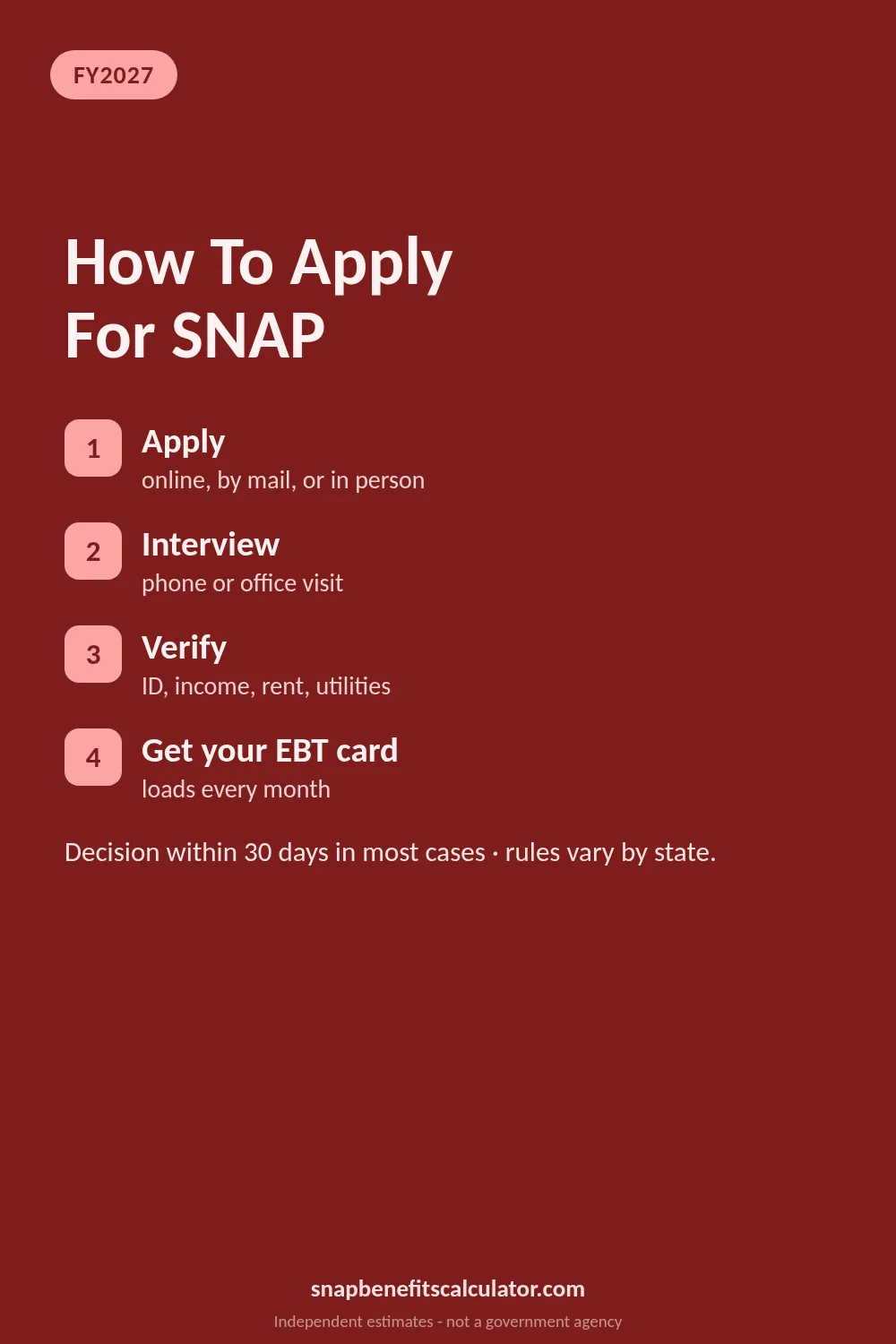
How to Apply for SNAP Benefits
Once the calculator shows you'd receive benefits, the next step is applying. Here's what to expect.
Every state has its own application portal. Most are available online 24/7. You can also apply by phone, mail, or in person at your local SNAP office.
The application asks for the same information as the calculator — household size, income, housing costs, and expenses. But it also requires verification documents and a phone or in-person interview.
Standard processing takes up to 30 days. But if your income is very low (under $150/month), you may qualify for expedited service with benefits arriving within 7 days or even the same day.
Documents You'll Need
- Government-issued photo ID (driver's license, state ID)
- Social Security numbers for all household members
- Proof of income (last 30 days of pay stubs or benefit letters)
- Proof of housing costs (lease, mortgage statement)
- Utility bills (if claiming shelter deduction)
- Childcare receipts or provider letter
- Medical bills (if senior or disabled)
Common Food Stamp Calculator Questions
How accurate is the food stamp calculator?
The calculator is typically within $20-$50 of the actual benefit amount. It uses the same federal formula caseworkers use. Variations come from state-specific rules and deductions the calculator doesn't account for.
Does using the calculator affect my credit or show up on records?
No. The calculator runs entirely in your browser. No data is sent to any server, no account is created, and nothing is reported to credit bureaus or government agencies. You can use it anonymously.
Can I get food stamps if I work full time?
Yes. SNAP is designed to supplement working families, not just the unemployed. A family of four with two working parents earning $15/hour each can earn up to $3,575/month and still qualify in most states.
Can I own a car and still qualify?
Yes. Federal rules exclude one vehicle of any value. Many states have eliminated the resource test entirely. Your car's value almost never affects SNAP eligibility.
How long does SNAP approval take?
Standard processing takes up to 30 days. But if you have very low income, you can get expedited SNAP within 7 days. About 20-25% of applications qualify for expedited service.
What if the calculator says I don't qualify?
The calculator is an estimate. State-specific rules may still qualify you. If you're close to the threshold, apply anyway — a caseworker may find deductions the calculator missed.
Can college students get food stamps?
Most students 18-49 can't get SNAP unless they meet an exemption. Working 20 hours/week, being in work-study, having a child under 12, or being in certain programs all qualify. Check with your campus financial aid office.
Can I use SNAP benefits online?
Yes. Most states participate in the USDA Online Purchasing Pilot. You can use your EBT card at Amazon, Walmart, and other approved retailers for grocery delivery. Delivery fees must be paid separately.
What Can You Buy with Food Stamps?
✅ Allowed
- Fresh, frozen, and canned fruits and vegetables
- Meat, poultry, fish, and seafood
- Dairy — milk, cheese, yogurt, eggs
- Bread, cereal, rice, pasta
- Snack foods and non-alcoholic beverages
- Seeds and plants that produce food
❌ Not Allowed
- Alcohol and tobacco
- Vitamins and supplements
- Hot prepared foods
- Pet food
- Paper products and cleaning supplies
- Cosmetics and hygiene products
Tips to Maximize Your SNAP Benefits
Getting the most from your food stamp benefits requires planning. Here are proven strategies to stretch your monthly allotment.
Claim every deduction. Document shelter costs, childcare, and medical expenses. Every dollar of deduction increases your benefit by 30 cents. Many applicants leave money on the table.
Report income drops immediately. If your income decreases, report it to your caseworker right away. SNAP can be recalculated mid-certification, and lower income means higher benefits.
Use farmers market programs. Many markets double your SNAP dollars through Double Up Food Bucks or similar programs. Spend $10, get $20 worth of fresh produce.
Shop sales and buy in bulk. Use your benefits for staple items like rice, beans, and frozen vegetables when they're on sale. Plan meals around what's discounted each week.
Don't give up after denial. Many initial denials get overturned on appeal. File within 90 days, bring additional documentation, and seek free legal help from legal aid organizations.
State-Specific Food Stamp Calculators
While the federal SNAP formula applies nationwide, some states have different income limits and rules. Here are state-specific guides:
Related Resources
Learn more about SNAP and food assistance with these guides:
- SNAP EBT Payment Schedule — When your benefits load each month
- California Food Stamp Calculator — CalFresh-specific guide
- About Wasim Akram — Learn about our founder and editorial standards
- Editorial Policy — How we research and maintain content
Conclusion
A food stamp calculator is the quickest way to find out if SNAP benefits are worth pursuing. Enter five numbers, get an instant estimate, and decide whether to apply.
Remember that SNAP is designed to help working families, seniors, students, and anyone struggling to afford groceries. The program serves over 40 million Americans — if you qualify, you're not alone.
If the calculator shows you'd receive benefits, don't wait. Apply through your state's portal today. The application takes about 30 minutes, and you could have food assistance within days.
For state-specific information, browse our state SNAP calculators or check the payment schedule guide to learn when your benefits would arrive.
Ready to Calculate Your Benefits?
Use our free food stamp calculator at the top of this page. It takes 2 minutes.
Calculate My Benefits →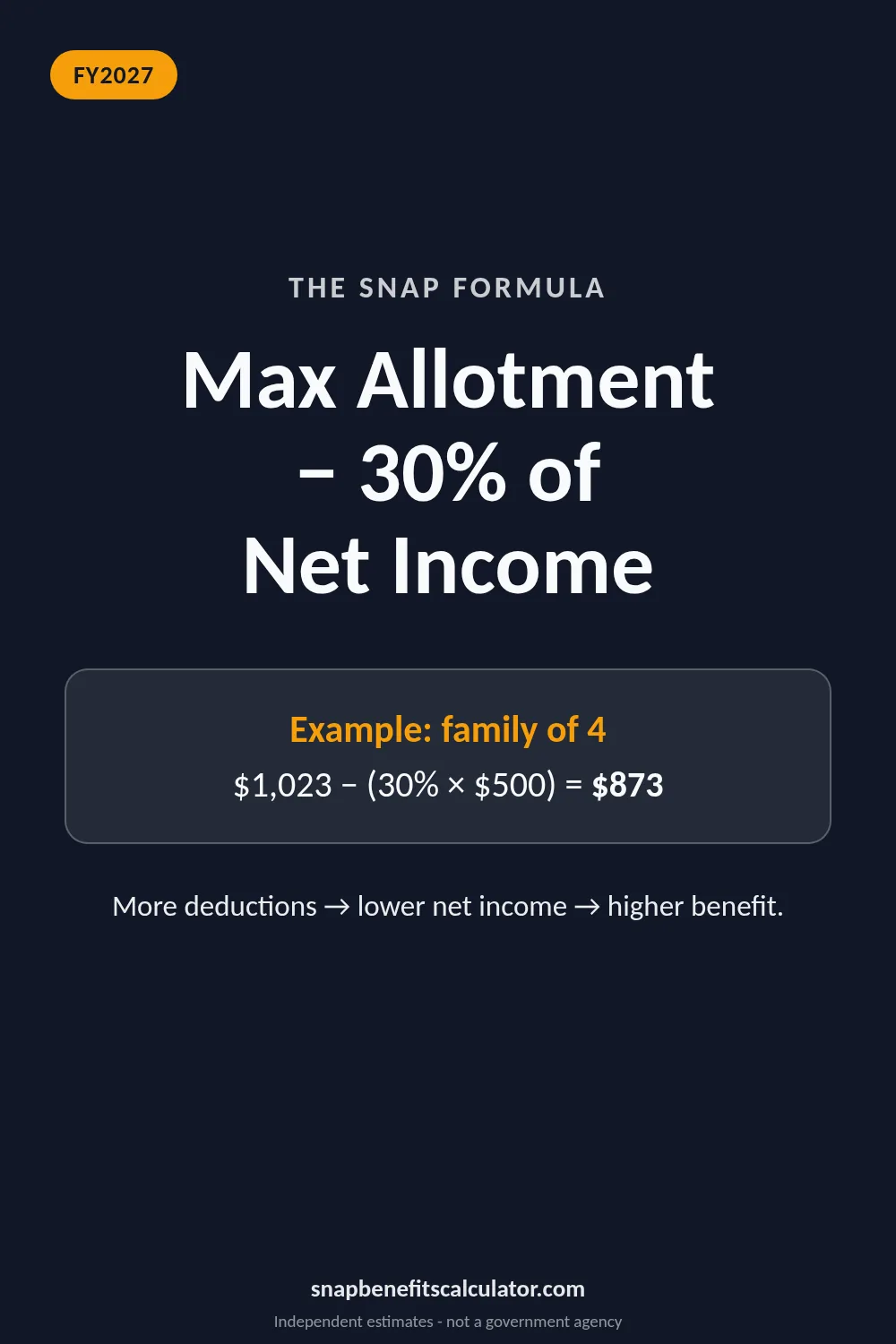
The SNAP formula: max allotment minus 30% of net income.
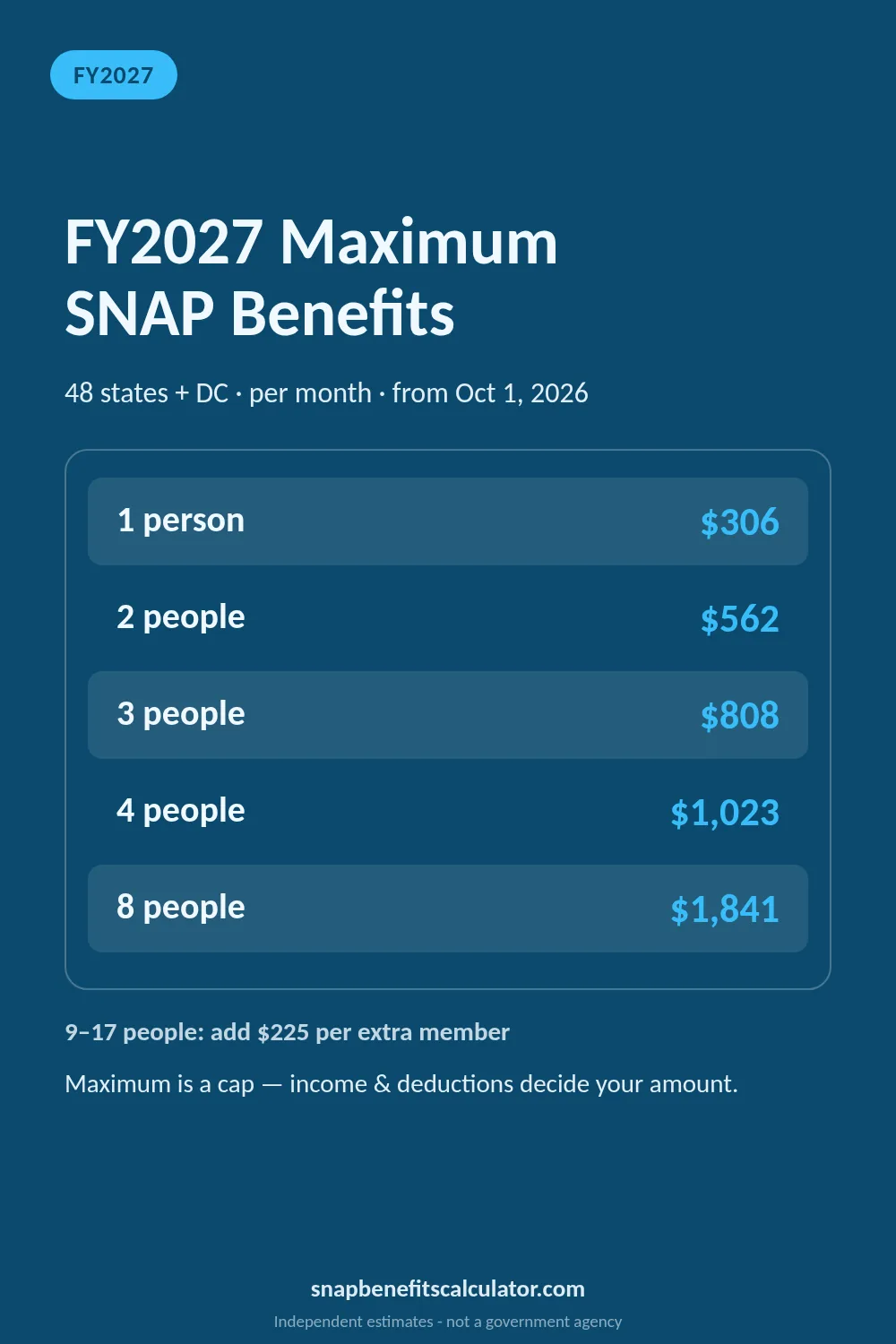
Maximum monthly SNAP benefit amounts for FY2027, effective October 1, 2026.
Four main eligibility requirements for SNAP.
Understanding Your EBT Card
Once approved for SNAP, you'll receive an Electronic Benefit Transfer (EBT) card in the mail. It works like a debit card at authorized retailers nationwide.
You'll create a four-digit PIN to secure your card. Never share this PIN with anyone — not even store employees. If someone gets your card and PIN, they can spend your benefits.
Benefits load on the same date each month. Your deposit date is determined by your state's rules — usually based on your case number or last name. The date doesn't change month to month.
You can check your balance by calling the EBT customer service number, using the mobile app, or checking your last grocery receipt. All options are free and available 24/7.
SNAP Recertification — Keeping Your Benefits
SNAP benefits don't last forever. You need to recertify periodically to keep receiving them. Most households recertify every 6 to 12 months.
You'll receive a renewal notice about 45 days before your recertification deadline. The packet includes forms to update your information and a list of documents to provide.
Fill out the forms completely, attach the required documents, and submit them before the deadline. You'll also need to complete a short phone interview.
If you miss the deadline, your benefits will stop. You'd need to reapply from scratch — which means another 30-day processing wait. Don't let this happen.
When to Report Changes to SNAP
Between recertifications, you must report certain changes within 10 days. Failing to report can lead to overpayment, which means paying back benefits.
Income changes: If your income goes up or down significantly, report it. A decrease in income could increase your benefit. An increase might reduce it — but not reporting is worse.
Household size changes: If someone moves in or out, report it. This affects both your benefit amount and eligibility.
Address changes: Always report a new address. Benefits are state-specific, and moving to a different state requires a new application.
Shelter or childcare cost changes: If your rent goes up or childcare costs change, report it. Higher costs can increase your deductions and your benefit.
Expedited SNAP — Fast Benefits for Urgent Needs
If your household has very low income and resources, you may qualify for expedited SNAP. This means benefits arrive within 7 days instead of the standard 30 days.
You qualify if your monthly income is under $150 and you have less than $100 in resources. Migrant farmworker households and households whose income and resources are less than their monthly rent also qualify.
About 20-25% of SNAP applications get expedited processing. You still need to complete verification, but you get food money while that happens.
If you're struggling to buy food right now, mention expedited service when you apply. The caseworker will screen you for it automatically, but it doesn't hurt to ask.
SNAP for Seniors — Special Rules and Benefits
Seniors age 60 and older have access to special SNAP rules that can increase their benefits. Many seniors qualify but don't apply because they think their Social Security income disqualifies them.
The biggest advantage is the medical expense deduction. Seniors can deduct out-of-pocket medical costs over $35 per month. This includes Medicare premiums, prescription copays, dental bills, eyeglasses, hearing aids, and mileage to medical appointments.
Seniors are also exempt from the gross income test. They only need to meet the net income test, which is more lenient because it accounts for deductions.
Additionally, seniors can use simplified application processes in many states. These shorter forms require less documentation and are easier to complete.
If you're a senior receiving SSI, you can apply for SNAP at your Social Security office. They'll forward your application to your local SNAP agency. Many SSI recipients get $100 or more per month in food benefits.
Common Mistakes That Reduce Your SNAP Benefits
Many applicants receive less than they should because of simple mistakes. Here are the most common ones to avoid.
Not claiming all deductions. This is the biggest mistake. Many people only report rent and forget utilities, childcare, or medical expenses. Every missed deduction means less money in your pocket each month.
Underreporting household size. Some applicants don't count elderly parents or adult children who share meals. A larger household means higher maximum benefits and higher income limits.
Missing the interview. After submitting your application, a caseworker will call to schedule an interview. If you miss the call and don't reschedule, your application gets delayed or denied.
Not submitting verification documents. You typically get 10 days to provide proof of income, rent, and expenses. Missing this deadline pauses your application. Submit everything promptly.
Giving up after denial. Many initial denials get overturned on appeal. If you're denied, file an appeal within 90 days. Bring additional documentation to the hearing. Legal aid organizations provide free representation.