This California food stamp calculator guide estimates your CalFresh benefits using the official FY2027 formula that county workers follow. Every dollar figure below reflects the current fiscal year.
CalFresh is California's name for SNAP. The federal program loads monthly grocery money onto a Golden State Advantage EBT card. At the register it swipes like any bank-issued card.
Run the free California CalFresh calculator first for an instant estimate. This guide explains how the math works, what qualifies you, and when your benefits land.
Behind the California Food Stamp Calculator
The calculator mirrors the same formula county eligibility workers apply when they process a CalFresh application. It follows USDA rules plus the California adjustments that make the state more generous than most.
The core math is simple. Your monthly benefit equals the maximum allotment for your household size, minus 30% of your countable net income.
Deductions come out of your gross income first, and the remainder is your net income. Those deductions cover a standard amount, 20% of earned income, shelter costs, childcare, and medical expenses for seniors.
The calculator asks five questions — household size, gross monthly income, housing costs, and childcare costs. A sixth input flags any member who is 60-plus or disabled. County applications ask the same questions, so nothing extra is required.
Your answers feed the formula and return an estimated monthly amount. More accurate inputs produce an estimate that lands closer to your approved benefit.
What You Need to Calculate Your Benefits
Gather five pieces of information before you start. Accurate numbers now save you from surprises later.
First, count your household size — everyone who lives with you and shares meals. Include children, spouses, and elderly parents; exclude roommates who buy and prepare food separately.
Second, add up gross monthly income before taxes — wages, self-employment, Social Security, unemployment, and child support received.
Third, list what you pay monthly for housing — rent or mortgage, property taxes, plus utility bills. California's Standard Utility Allowance lets many renters add a fixed $663 instead of tracking every bill.
Fourth, add childcare costs that let you work or attend school. Fifth, note whether anyone is 60 or older or receives disability benefits, because extra deductions follow.

California CalFresh Income Limits for 2026
Broad-based categorical eligibility — BBCE for short — is why California's gross income ceiling sits far above the federal floor. Most states cap gross income at 130% of poverty; California screens households at 200%.
The current fiscal year runs from October 1, 2026 through September 30, 2027. A single person can gross up to $2,660 monthly. Households of four can reach $5,500 and still qualify.
| Household Size | Gross Income Limit (200% FPL) | Max Monthly Benefit |
|---|---|---|
| 1 person | $2,660 | $306 |
| 2 people | $3,608 | $562 |
| 3 people | $4,554 | $808 |
| 4 people | $5,500 | $1,023 |
| 5 people | $6,448 | $1,217 |
| 6 people | $7,394 | $1,463 |
| 7 people | $8,340 | $1,616 |
| 8 people | $9,288 | $1,841 |
Each extra household member raises the gross ceiling by about $948 and the maximum benefit by $225. USDA adjusts every figure each October through its annual cost-of-living announcement.
Fresh limits take effect on October 1, 2026. The one-person federal cap rises to about $1,729, which lands near $2,660 under California's 200% screen.
Households with a 60-plus or disabled member skip the gross screen entirely. They qualify under the net-income screen instead — $1,330 for one person, $2,750 for four.
Our SNAP income limits guide compares every state's ceilings side by side.
Factors That Affect Your CalFresh Benefit Amount
Four levers shape your final benefit: household size, income, deductions, and your state's benefit table.
Household Size
Bigger households open higher maximum allotments. One person tops out at $306 monthly under FY2027 values; households of four can reach $1,023.
Household size counts everyone who lives and eats together. Roommates who shop and cook separately are treated as their own household, even under one roof.
Gross Monthly Income
Everything you earn before taxes is the starting point. Wages, gig work, self-employment, Social Security, unemployment, and child support received all count.
Higher income lowers the benefit. Even so, California's 200% ceiling keeps many full-time workers eligible — a threshold most states never reach.
Standard Deduction
Every household gets a standard deduction automatically — no paperwork involved. For FY2027 it is $217 for households of one to three and $229 for four. Five-person households deduct $268, and six or more deduct $308.
This deduction lowers your countable income before any other math happens. Larger automatic deductions mean a smaller 30% reduction from your maximum allotment.
Shelter Costs
Rent or mortgage payments, property taxes, plus utility bills all feed the shelter deduction. California's Standard Utility Allowance adds a fixed $663 for households with separate heating or cooling bills. Few states offer a bigger utility deduction.
If shelter costs exceed half your adjusted income, the excess becomes deductible. Most households claim up to the FY2027 cap of $769. Households with a senior or disabled member face no cap.
Federal rules changed how some utility deductions work beginning November 1, 2025. Households without a senior or disabled member may claim a reduced allowance. The California Department of Social Services posts the details.
Childcare Expenses
Childcare that lets you work, attend school, or join training counts as a full deduction. Daycare centers, after-school care, and even informal babysitting arrangements qualify with receipts.
Save your payment records. County workers usually ask for documentation during the interview, and organized receipts speed up approval.
Medical Costs for Seniors and Disabled Members
Households with a member 60-plus or disabled may deduct self-paid medical costs above $35 per month. Medicare premiums, prescriptions, dental work, eyeglasses, and ride costs to appointments all qualify.
This deduction gets overlooked constantly. Seniors who track every medical receipt often watch their benefit rise noticeably. That single habit changes budgets.
Real CalFresh Estimates: Two Worked Examples
Numbers click faster with real budgets. Both examples use the FY2027 deductions and allotments shown above.
Working Family of Three in Fresno
This household earns $3,600 gross from one job and pays $1,650 in rent. The 20% earned income deduction removes $720, and the $217 standard deduction brings countable income to $2,671.
Rent of $1,650 plus the $663 utility allowance totals $2,313 in shelter costs. The excess over half their adjusted income reaches the $769 cap.
Net income lands at $1,927, and 30% of that is $579 after rounding. The three-person maximum of $808 minus $579 leaves a $206 monthly benefit.
Retired Senior in Sacramento
A 68-year-old renter receives $1,910 in Social Security and pays $1,150 in rent. Because she is over 60, only the net-income screen applies.
The standard deduction drops her countable income to $1,701. Medical costs above the $35 threshold remove another $105, bringing it to $1,596.
Her shelter costs of $1,813 exceed half her income by $1,015 — fully deductible with no cap for seniors. Net income of $581 turns into a $175 reduction, leaving a $123 monthly benefit from the $306 maximum.
Both estimates assume every deduction gets documented. Missed paperwork is the most common reason real benefits come in lower than calculator results. Our SNAP maximum allotments guide tracks every household size.
California Food Stamp Calculator: Six Steps to Your Estimate
The calculator takes about two minutes. Work through these six steps for the sharpest estimate.
Step 1: Type in your household size — everyone who lives and shares meals with you, children included. Shared-meal rule beats shared-address rule here.
Step 2: Add up gross monthly income from every source, before taxes. When in doubt, round up — county workers verify against pay stubs.
Step 3: Enter monthly housing costs. If utilities are billed separately, add California's $663 standard utility allowance.
Step 4: Include childcare expenses you pay in order to work or attend school. Costs that free you up for job training count as well.
Step 5: Check the senior or disabled box when someone is 60-plus or receives disability benefits. Extra deductions follow automatically.
Step 6: Click calculate. The tool applies the official formula and posts your estimate instantly.
A Note on Estimate Accuracy
Every estimate has limits. A caseworker verifies documents that no online tool can see, so your approved amount may differ. Treat it as planning help, not a guarantee — apply through GetCalFresh.org or BenefitsCal.com for the official determination.
California CalFresh vs. Federal SNAP — What's Different?
CalFresh runs on federal SNAP money and rules, but California layers state choices on top that change who qualifies.
The income ceiling is the headline difference. California screens gross income against 200% of poverty via BBCE, while most states stop at 130%.
California also dropped the asset test entirely. Savings, retirement accounts, and vehicle value never count against you here. In asset-test states, $3,000 in the bank can end eligibility.
The utility allowance is another outlier. California's $663 SUA towers over the deductions used in lower-cost states, which boosts shelter deductions for renters.
Finally, California funds CFAP — the California Food Assistance Program — for some immigrant households shut out of federal CalFresh. Benefits match federal amounts and come from state money. Our categorical eligibility guide explains how BBCE works nationally.
Do You Qualify for CalFresh in California?
Four gates decide eligibility: income, residency, work status, and identity.
Income Requirements
Gross income must sit at or below 200% of poverty. In FY2027 that means $2,660 monthly for one person and $5,500 for four.
Households with a senior or disabled member follow the net test at 100% of poverty instead of the gross screen.
Residency Requirements
California residency is required. You also need to meet federal immigration status rules. Lawful permanent residents generally qualify after five years in that status.
Federal law passed in 2026 narrowed some noncitizen categories, so rules that guided past applications may no longer apply. The California Department of Social Services maintains the current eligibility list, and county workers can check your situation.
Work Requirements
Most adults face basic work registration — accepting suitable job offers and not quitting without good cause.
Stricter ABAWD rules now cover ages 18 through 64 following the 2026 federal expansion. Affected adults must average 80 hours of work or training monthly or use a three-month grace period within 36 months.
Exemptions still protect households with young children, pregnant participants, veterans, neighbors without housing, and former foster youth. Some counties also carry waiver coverage — ask your county office what applies locally.
Identity and Household Composition
Bring a government photo ID and Social Security numbers for every household member, or proof that numbers were applied for.
Households form around meals, not leases. Relatives who eat together usually file as one household; separate-meal roommates file separately.
Three Ways to Apply for CalFresh
Three application channels reach the same outcome. Pick whichever fits your schedule.
Apply online: GetCalFresh.org and BenefitsCal.com both take applications around the clock. Most applicants wrap up in roughly 30 minutes and can save progress midway.
Apply by phone: county social services staff complete applications with you over the phone.
Apply in person: county offices accept paper applications and offer staff help — bring your paperwork along.
Documents to Have Ready
Pull these together before you apply; complete packets move faster.
- California driver's license or state ID
- Social Security numbers for all household members
- Proof of income (last 30 days of pay stubs)
- Proof of housing costs (lease or mortgage statement)
- Utility bills (if claiming the SUA deduction)
- Childcare receipts or a letter from your provider
- Medical bills (if senior or disabled)
- Proof of immigration status (if applicable)
After You Submit Your Application
Counties must decide within 30 days, though many households hear back sooner.
3-Day Expedited CalFresh
Federal law obligates counties to issue benefits within three calendar days when a household qualifies. You qualify if gross income sits under $150 with $100 or less in cash. Households whose income plus cash is less than monthly rent and utilities also qualify.
Expedited service gets food money moving while verification continues in the background. Your regular card arrives once the county finishes its checks.
The Interview
A county worker calls for your interview, usually by phone, and it rarely passes the half-hour mark. They confirm your details and walk through your rights. If you miss it, call your county office the same day to reschedule.
Receiving Your EBT Card
The Golden State Advantage card arrives by mail within a week to ten days of approval. Activate it by phone and set your PIN.
Benefits load once a month on a fixed date. California assigns that date from your case number's final digit, which we break down below.
California CalFresh Payment Schedule
CalFresh deposits arrive between the 1st and 10th of every month. The final digit of your case number sets the day — the same schedule every month, weekends included.
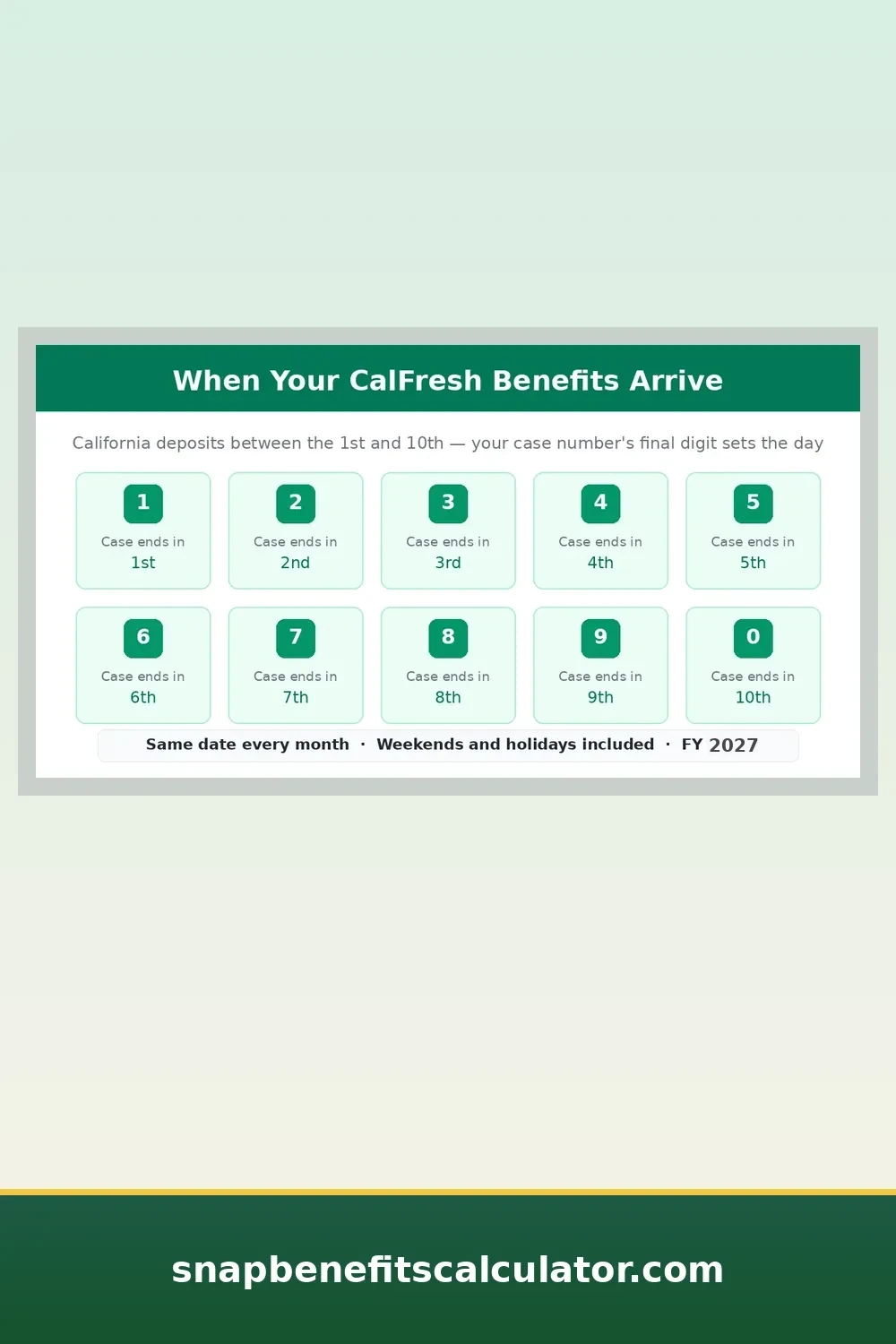
| Case Number Ends In | Benefits Deposit |
|---|---|
| 1, 2, 3, 4, or 5 | Same day as the digit — the 1st through the 5th |
| 6, 7, 8, or 9 | Same day as the digit — the 6th through the 9th |
| 0 | The 10th of the month |
A case number ending in 3 loads benefits on the 3rd; a zero loads on the 10th. Deposits post around midnight, so check your balance the next morning if nothing shows at night.
Your date never changes month to month, which makes grocery planning predictable. Our SNAP EBT payment schedule guide lists every state's deposit window.
Spending Your CalFresh in California
The Golden State Advantage card works at tens of thousands of stores statewide. Swipe it like any bank card, enter your PIN, and the total leaves your balance.
Stores and Markets That Take EBT
Safeway, Ralphs, Vons, Food 4 Less, Walmart, and Target all take EBT. Most neighborhood markets do too, and online orders go through Amazon and Walmart.
California's farmers markets accept EBT too, and many join Market Match, which stretches CalFresh dollars for fresh produce. Ask the market manager about the current match amount before you shop.
Tracking Your EBT Balance
Your balance shows for free on the customer service line at 1-877-328-9677 and in the ebtEDGE app. The state EBT site and your latest store receipt work too, all day, every day.
Common CalFresh Myths in California
Myth: "My family earns too much to bother applying."
California's 200% screen lets households of four earn $5,500 monthly and still qualify. Plenty of working families clear that bar without knowing it.
Myth: "Our car probably disqualifies us."
California dropped the asset test. Your vehicle, savings, and retirement accounts stay invisible to the eligibility math.
Myth: "Without papers, my family is out of luck."
Undocumented parents can apply on behalf of their U.S. citizen kids. The children qualify on their own status, and parent information stays confidential.
Myth: "The paperwork will swallow my whole weekend."
GetCalFresh.org walks you through each screen, saves your progress, and finishes in minutes, not weekends.
CalFresh for Special Populations
Seniors and CalFresh
Seniors 60-plus gain the medical expense deduction, the uncapped shelter deduction, and the net-income-only test. Lots of seniors assume Social Security checks cancel them out — in most cases they don't.
College Students and CalFresh
Students enrolled half-time or more need an exemption on top of income limits. Working 20 hours weekly, approved work-study, or parenting a child under 12 all qualify. Several California campuses station outreach workers who help students apply on the spot.
Immigrants and CalFresh
The 2026 federal law trimmed which noncitizen groups qualify, though lawful permanent residents with five years remain eligible. Children in many statuses keep coverage, and CFAP covers some households with state money. County workers and immigration legal aid can review specific cases safely.
SSI Recipients and CalFresh
Since June 2019, people receiving SSI in California have been able to enroll in CalFresh. SSI/SSP income counts toward the budget, but separate state rules make approval easier. Our SNAP minimum benefit guide explains the floor for smaller awards.
Getting More From Every CalFresh Dollar
Small moves change monthly amounts. These five habits come straight from veteran recipients and county caseworkers.
Claim every deduction. Childcare, medical, and shelter deductions slip through the cracks most often, and each documented dollar raises the benefit.
Use the utility allowance. Any household billed separately for heat or cooling should claim the $663 SUA — it feeds the shelter deduction directly.
Stretch dollars at farmers markets. Market Match multiplies your produce budget at participating stands, so ask about the daily match cap.
Report income drops right away. Lower verified income can raise your benefit mid-certification.
Appeal denials within 90 days. Many overturned decisions come down to paperwork that finally arrived.
Other California Food Assistance Programs
CalFresh pairs with several companion programs, and qualifying for one often opens the others.
WIC supports expecting moms, new mothers, and children under 5 at 185% of poverty, right alongside CalFresh. School meals come free to kids in CalFresh homes with no separate application.
SUN Bucks adds $120 per school-age child each summer to replace cafeteria meals. Senior nutrition programs — Meals on Wheels and congregate meal sites — feed adults 60-plus with lighter income screens.
CalFresh Recertification in California
Approval is not forever. Most households renew every 12 months, while senior-only or disabled-only households can stretch to 24.
California uses semi-annual reporting between renewals. Your SAR-7 report lands around month six and asks for income and household updates. Counties mail the full recertification packet before your certification period ends, so watch your mailbox and respond early.
Report address changes promptly and answer county letters quickly. Skipped paperwork stops benefits, and unreported changes can create overpayments you would have to repay.
CalFresh in Major California Cities
Rules stay statewide, but county offices run the program day to day. Here is where the largest populations apply.
Los Angeles
LA County runs the largest CalFresh caseload in America — well over a million neighbors receive benefits. The Department of Public Social Services takes applications at 1-866-613-3777 and through BenefitsCal. County food banks offer free application help inside libraries and community centers.
San Francisco
High living costs push many San Francisco residents into eligibility despite strong wages. The Human Services Agency processes cases, and farmers markets across the city run Market Match daily.
San Diego
San Diego County HHSA takes applications at 1-866-262-9881 and online. The county food bank network provides bilingual application support at multiple sites.
Sacramento
In Sacramento, the county DSS runs CalFresh at offices across the city. Local food bank staff handle CalFresh alongside Medi-Cal and WIC questions in a single visit.
CalFresh Resources in California
Apply Online
GetCalFresh.org or BenefitsCal.com
EBT Customer Service
1-877-328-9677
LA County DPSS
1-866-613-3777
California 211
Call 211 for local help
CDSS CalFresh Info
cdss.ca.gov/calfresh
CalFresh FAQs
How accurate is the California food stamp calculator?
It applies the same federal formula counties use. Documented deductions can shift the final approved amount up or down.
Can I own a car and still get CalFresh?
Yes. California has no asset test, so vehicles, savings, and retirement funds don't count.
How long does approval take in California?
Counties get 30 days for standard cases. Qualifying households receive expedited benefits within three calendar days.
What's the difference between CalFresh and SNAP?
Just the name. CalFresh is California's version of the same federally funded program.
Can college students get CalFresh?
Yes, with an exemption — 20 work hours weekly, work-study, or a child under 12 all count. Campus outreach workers can point you to the right paperwork.
Can I use CalFresh at farmers markets?
Yes. Hundreds of California markets accept EBT, and many match dollars through Market Match. Ask the manager for the daily cap.
What if my application is denied?
Appeal within 90 days through your county office. Fresh documentation overturns many denials.
Do SSI recipients qualify for CalFresh?
Yes. SSI recipients have qualified since June 2019, and many receive meaningful monthly food benefits. Apply the same way as anyone else.
Do CalFresh benefits roll over month to month?
They do. Unspent balances carry forward on your EBT card and expire only after 365 days.
How much does a single person get in 2026?
Up to $306 monthly in FY2027, with a $25 minimum for one- and two-person households. Actual amounts drop as countable income rises.
The Bottom Line
The California food stamp calculator turns a confusing eligibility system into a two-minute estimate. Use it before applying to see whether the paperwork is worth your afternoon.
California runs the friendliest SNAP math in the country. The state screens income at 200%, skips asset tests, and allows a $663 utility allowance. More households qualify here than almost anywhere else.
If your estimate shows a benefit, apply at GetCalFresh.org the same day. Filing takes about 30 minutes, and approved households could see food money within days.
Compare your result on the California CalFresh Calculator page, or browse every state SNAP calculator.
Related SNAP Guides
These guides go deeper on the rules behind your estimate.
- How SNAP eligibility is decided
- SNAP income limits by state
- SNAP maximum allotments for 2026
- Every SNAP deduction explained
- SNAP minimum benefit rules
- How categorical eligibility works
- Who qualifies for SNAP
Ready to Calculate Your Benefits?
Run your numbers on the free California food stamp calculator.
Calculate My CalFresh Benefits →