SNAP income limits decide who qualifies: a gross income test at 130% of the federal poverty level and a net income test at 100%. For fiscal year 2026, a single person passes the gross test with monthly income at or below $1,696 and the net test at or below $1,305. A family of four faces limits of $3,483 gross and $2,680 net.
Most states add a third, higher number. Through a rule called broad-based categorical eligibility, they raise the gross limit to 200% of poverty — $5,360 a month for a family of four. A handful of states keep the 130% limit, so where you live changes which numbers actually apply to you.
This guide lays out both tests with the official 2026 figures, explains which income counts and which never does, lists every deduction that turns gross into net, and walks through a real two-person budget the same way a caseworker would.
What Are the SNAP Income Limits?
USDA resets the limits every October 1 to match inflation. The chart below covers fiscal year 2026, effective October 1, 2025 through September 30, 2026, for the 48 contiguous states and Washington, D.C. Alaska, Hawaii, Guam, and the U.S. Virgin Islands set higher limits because of higher living costs (USDA eligibility standards).
| Household size | Gross monthly limit (130% of poverty) | Net monthly limit (100% of poverty) |
|---|---|---|
| 1 | $1,696 | $1,305 |
| 2 | $2,292 | $1,763 |
| 3 | $2,888 | $2,221 |
| 4 | $3,483 | $2,680 |
| 5 | $4,079 | $3,138 |
| 6 | $4,675 | $3,596 |
| 7 | $5,271 | $4,055 |
| 8 | $5,867 | $4,513 |
| Each additional person | +$596 | +$459 |
The gross column is the first gate. If your household's total income before any deductions is above the number for your size, you fail the gross income test — unless your state uses the 200% option covered further down, or someone in the household is elderly or disabled and different rules apply.
⚠️ Watch out for old numbers. Income limits reset every October. Articles quoting a $204 standard deduction or a $712 shelter cap are describing FY2025. For FY2026 the standard deduction is $209 and the shelter cap is $744.
Gross Income vs Net Income: What's the Difference?
Gross income is everything your household receives before anything is subtracted: wages before taxes and paycheck deductions, self-employment income after legitimate business expenses, Social Security, unemployment benefits, pensions, and child support you receive. Net income is what remains after SNAP subtracts its approved deductions from that gross figure.
Households with no elderly or disabled member must pass both tests. Households that contain a member age 60 or older, or a member receiving disability benefits, are usually budgeted on net income alone — one of several ways the program adjusts for fixed incomes and high medical bills.
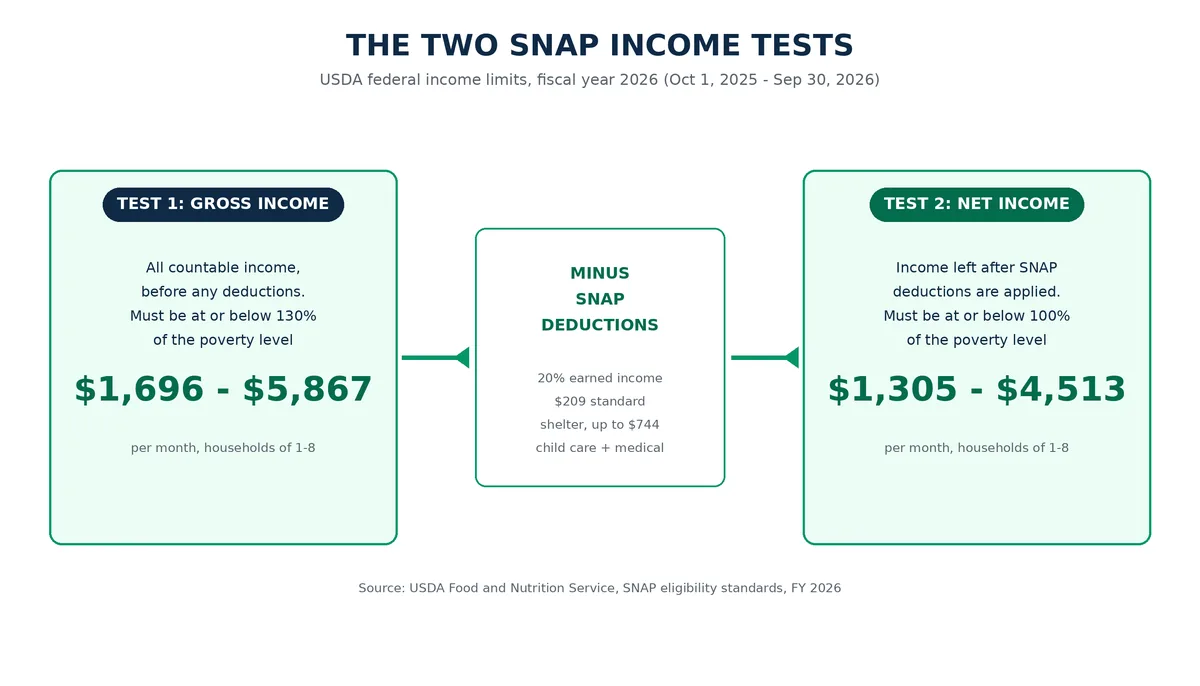
The space between the two limits is where deductions earn their keep. A household sitting $200 over the gross limit can still land under the net limit once rent, childcare, and the standard deduction come out. That is why the deduction list later in this guide matters as much as the limits themselves.
What Counts as Income?
SNAP splits countable income into two buckets. Earned income is money from work you or a household member performs. Unearned income is money that arrives without labor — and it counts dollar for dollar with no 20% break.
- Earned: wages, salaries, and tips before taxes; self-employment income after allowed business expenses.
- Unearned: Social Security and SSI, unemployment compensation, workers' comp, child support received, pensions and annuities, interest and dividends.
What Does Not Count as Income?
Several money streams never touch the SNAP budget. In-kind help — free housing, meals from a food pantry — is not income, and neither are WIC or school meal benefits. Education money such as Pell Grants and student loans is excluded, as are tax refunds and credits like the Earned Income Tax Credit, loans that must be repaid, and small irregular gifts. Your caseworker applies the full state list, because a few categories differ from state to state.
Net Income Limits and the Deductions That Get You There
The net column in the chart above is where most SNAP decisions land. These are the deductions USDA allows when caseworkers turn your gross income into a net figure:
- 20% of earned income — automatic, for every dollar of wages.
- Standard deduction — $209 for households of 1 to 3 people, higher for larger households.
- Dependent care — childcare or adult care costs that let you work, look for work, or attend training or school.
- Medical expenses over $35 a month for household members who are 60+ or disabled.
- Child support you legally owe and pay, in states that allow the deduction.
- Homeless shelter deduction — a flat $198.99 for households without a fixed address.
- Excess shelter costs — utilities, rent or mortgage, and taxes above half of your adjusted income, capped at $744 unless someone is elderly or disabled.
Shelter math trips up the most people. You add your rent plus your state's utility standard, compare it to half of your income after the other deductions, and anything above that half counts — up to the $744 cap. Renters in high-cost states usually max the cap out; homeowners with paid-off houses often get nothing from it.
💡 Key takeaway: deductions are the whole game between the 130% and 100% limits. Two neighbors can earn identical wages, yet the one with high rent and a child in daycare clears the net test while the other does not. Estimate both tests with the free SNAP benefit calculator before you assume you earn too much.
Income Limits for Elderly or Disabled Households
When a household includes someone age 60 or older, or a member receiving disability benefits such as SSDI, several limits loosen. The gross income test usually disappears — the household is evaluated on net income only. The $744 shelter cap lifts entirely, so every dollar of excess housing cost counts. Medical bills above $35 a month become deductible. And the resource limit rises from $3,000 to $4,500 (USDA special rules for the elderly or disabled).
There is also a separate-household option: an elderly or disabled person who cannot buy and cook food alone can be a SNAP household of one, as long as everyone else they live with stays under 165% of the poverty level. That rule keeps seniors in family households from being denied because of a working adult child's income.
The 200% Gross Income Rule in Most States
Here is the number most applicants never hear about. Under broad-based categorical eligibility (BBCE), states can raise the gross income limit to 200% of poverty — most states now do. The household still must pass the net income test and the deductions still apply, but the first gate moves dramatically higher.
| Household size | 200% gross monthly limit (BBCE states) |
|---|---|
| 1 | $2,610 |
| 2 | $3,526 |
| 3 | $4,442 |
| 4 | $5,360 |
A family of four earning $4,900 a month fails the 130% test — $3,483 — but clears the 200% bar of $5,360 with room to spare, and its high shelter costs may still produce a benefit. Because BBCE is optional, your state decides. A household in a state that kept the 130% limit faces the lower gate with no workaround, which is one more reason state guides matter.
Worked Example: A Two-Person Household
Nothing explains the two tests better than real arithmetic. Take a two-person household — a couple renting in a mid-cost city — with $2,200 a month in wages and $1,550 in total shelter costs: $1,100 rent plus a $450 utility standard.
- Start with gross income: $2,200. The 130% limit for two people is $2,292, so they pass the gross test.
- Subtract 20% of earned income (−$440): the figure drops to $1,760.
- Subtract the $209 standard deduction: $1,551 — this is their adjusted income.
- Shelter test: half of $1,551 is about $776. Their $1,550 shelter cost exceeds it by $774 — above the cap, so the deduction is limited to $744.
- Net income: $1,551 − $744 = $807. The net limit for two people is $1,763, so they pass the net test comfortably.
They qualify — and the benefit formula uses that net figure directly. The maximum allotment for two people is $546 in FY2026; SNAP subtracts 30% of net income ($807 × 0.30 = $242.10) and expects the household to cover the rest from its own money: $546 − $242.10 = $303.90, rounded down to $303 per month.
✅ Key takeaway: this household looked "over income" to a friend comparing gross wages. Deductions — $440, $209, and $744 of shelter — cut the counted income by nearly two-thirds. Curious about bigger awards? See how some Pennsylvania households reach $1,000 a month.
What If Your Income Is Over the Limit?
First, re-run the math with every deduction — not the number on your paycheck. Applicants routinely disqualify themselves by comparing gross wages to the gross limit while ignoring shelter, childcare, and the standard deduction. The gap between the 130% and 100% tests exists precisely so those costs can count.
Second, check your state's gross limit. If it uses the 200% BBCE option, the ceiling for a family of four is $5,360, not $3,483. State-by-state details live in our guides — start with California SNAP income limits, Texas SNAP income limits, or Florida SNAP eligibility, or find your state's SNAP guide in the full list.
Third, remember that eligibility is measured on the day the state processes your application. Hours get cut, jobs end, a new baby arrives and raises the household size. If you were denied once, a changed budget can flip the answer — and if income drops after you apply, report it, because your benefit is recalculated from current numbers. When your EBT card is funded, deposits follow the monthly EBT payment schedule your state posts.
SNAP Income Limits FAQ
What is the highest income to qualify for SNAP in 2026?
In the 48 states and D.C., the standard gross ceiling runs from $1,696 for one person to $5,867 for eight, plus $596 per extra member. In states with the 200% BBCE option, a family of four can gross up to $5,360 and still be considered. Elderly and disabled households face the net test instead of a gross limit in most cases.
Is the SNAP income limit before or after taxes?
The gross test uses income before taxes and before paycheck withholdings — it is deliberately strict. The net test then subtracts SNAP's own deductions, which are different from tax deductions. That is why $2,200 in wages is above the single-person gross limit but can still qualify after deductions in a two-person household.
What income does not count for SNAP?
In-kind help like free housing or food pantry meals, WIC and school meal benefits, most education aid including Pell Grants and student loans, tax refunds and the EITC, repayable loans, and small irregular gifts all stay out of the budget. A few categories vary by state, so let the application ask the detailed questions rather than ruling yourself out.
Can I get SNAP if I work full time?
Yes — the tests look at income and deductions, not hours. Many full-time workers in high-rent areas qualify because the shelter deduction eats most of their wages on paper. One separate rule to know: able-bodied adults without dependents, now defined as ages 18 to 64, face a three-month SNAP time limit in any three-year period unless they work or train at least 80 hours a month, join a state employment program, or claim an exemption.
Do my car and savings account affect the income limits?
Assets are a separate test from income. The FY2026 limit is $3,000 in countable resources, or $4,500 when someone is 60+ or disabled — and most BBCE states have dropped the asset test entirely. Retirement accounts and the home you live in generally do not count; a second car's value might. Income limits and asset limits are checked side by side, not added together.
What if I pass both tests but get almost nothing?
Households whose net income is close to the limit can compute a benefit of just a few dollars. SNAP keeps a floor: eligible one- and two-person households receive at least $24 a month for FY2026. Larger households have no minimum — their benefit is simply the formula result, and Wisconsin's step-by-step calculation guide shows the arithmetic in detail.