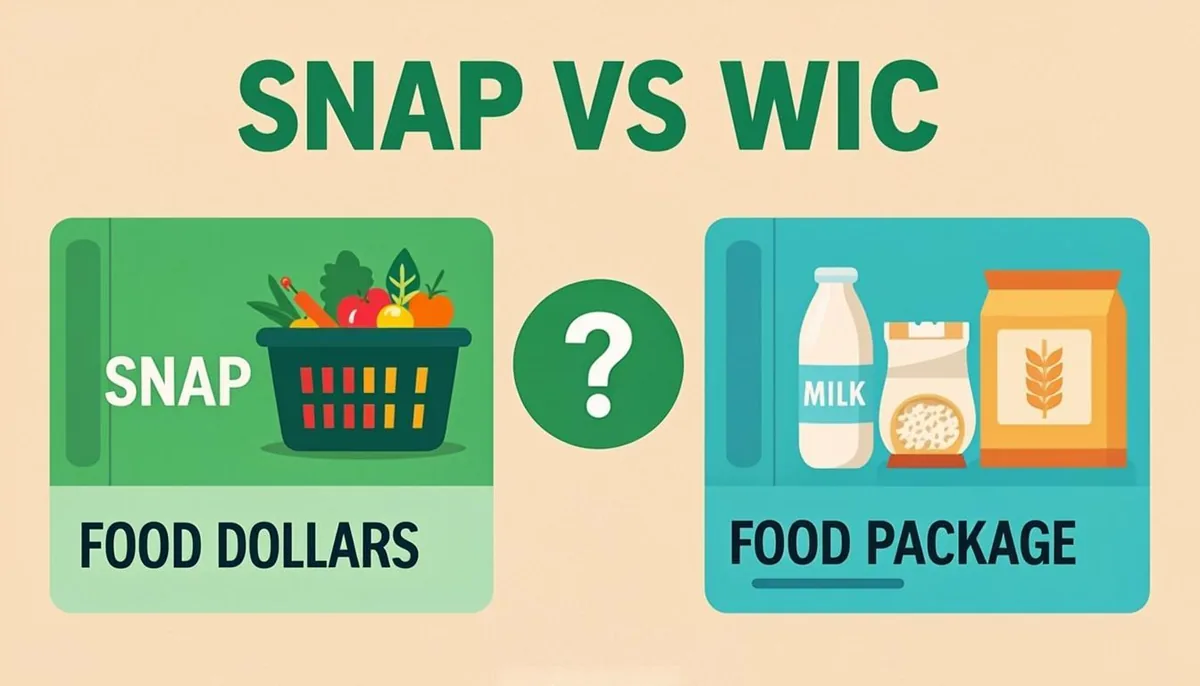
SNAP and WIC are two different programs with two different jobs. SNAP hands a monthly food budget to any low-income household on an EBT card. WIC delivers a fixed package of healthy foods to one specific group: pregnant and new mothers, babies, and children under five. One is a broad safety net; the other is a targeted nutrition program.
And yes — you can receive both at the same time. Approval for one actually helps with the other: a household already on SNAP or Medicaid automatically passes the WIC income test. Many families run an EBT card and an eWIC card side by side every month.
Below is the full comparison — who qualifies under each program's 2026 income limits, what each benefit buys, how the cards work, and the practical questions (like whether WIC shrinks your SNAP amount) that most articles skip.
What Is SNAP?
The Supplemental Nutrition Assistance Program is the country's main food benefit. It serves everyone from a single unemployed adult to a two-income family of six, and the benefit scales with household size and income — from the $24 minimum up to $994 a month for a family of four in fiscal year 2026.
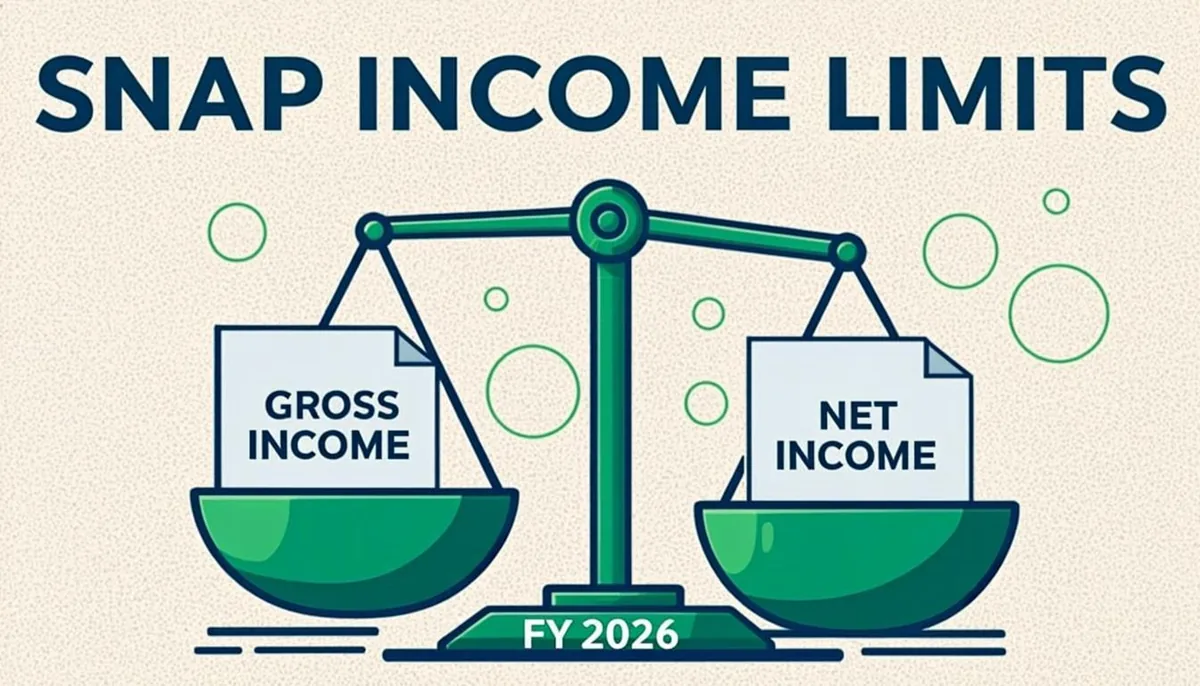
Eligibility runs through two income tests: gross income at or below 130% of the federal poverty level, and net income (after deductions) at or below 100%. Most states raise that first bar to 200% through a broad-based categorical eligibility option. Benefits arrive monthly on an EBT card that works like a debit card at grocery stores, and unused dollars roll over to the next month.
The short version: if your household eats and your income is limited, SNAP is built for you. Estimate your amount with the free SNAP benefit calculator before you apply anywhere.
What Is WIC?
The Special Supplemental Nutrition Program for Women, Infants, and Children targets a narrow window of life when nutrition matters most. WIC serves five groups: women who are pregnant, women up to six months postpartum, breastfeeding mothers up to the baby's first birthday, infants, and children up to their fifth birthday (USDA WIC eligibility).
Income limits sit at 185% of the federal poverty level for the 48 contiguous states and D.C., effective July 1, 2026 through June 30, 2027 (Federal Register income guidelines):
Household size | WIC monthly income limit (185% of poverty) |
|---|---|
1 | $2,461 |
2 | $3,337 |
3 | $4,212 |
4 | $5,088 |
Each additional member | +$1,095 |
A pregnant woman counts her unborn baby in the household size, which pushes the limit higher than it first looks. Every applicant also completes a free nutrition assessment with WIC staff — a short health screening, not a pass-or-fail exam. And there is no asset test: savings, a paid-off car, and retirement accounts do not block WIC.
SNAP vs WIC: Side-by-Side Comparison
Feature | SNAP | WIC |
|---|---|---|
Who it serves | Low-income households of any size — singles, seniors, working families | Pregnant and new mothers, infants, and children under 5 |
Income test | Gross income at or below 130% of poverty (200% in most states), then net income at 100% | Income at or below 185% of poverty — or automatic pass with SNAP, Medicaid, or TANF |
Work rules | Able-bodied adults 18-64 without dependents face a 3-month time limit | None |
Benefit form | Monthly food dollars loaded on an EBT card | A fixed food package loaded on an eWIC card |
Food choice | Almost any grocery food, plus seeds and plants that grow food | Specific approved foods: milk, eggs, cereal, whole grains, produce, formula, and more |
Asset test | $3,000 limit ($4,500 with a 60+ or disabled member); many states skip it | No asset test |
Duration | Ongoing eligibility with periodic recertification | Certification periods tied to the pregnancy or the child's age |
Program type | Entitlement — everyone who qualifies receives benefits | Grant-funded — states can build waitlists in tight years |
The design difference explains everything else. SNAP asks "is this household poor enough to need help buying food?" WIC asks "is this specific person at a life stage where good nutrition changes outcomes?" That is why a retired senior qualifies for SNAP but never for WIC, and why a nurse with a middle income can still get WIC for her newborn while making too much for SNAP.
Can You Get SNAP and WIC at the Same Time?
Yes, and the two programs are designed to stack. Federal rules make WIC applicants automatically income-eligible if anyone in the household receives SNAP, Medicaid, or TANF. Your SNAP approval letter effectively doubles as a WIC income test pass — you still complete WIC's nutrition assessment and pick up your eWIC card, but the income paperwork shrinks to almost nothing.
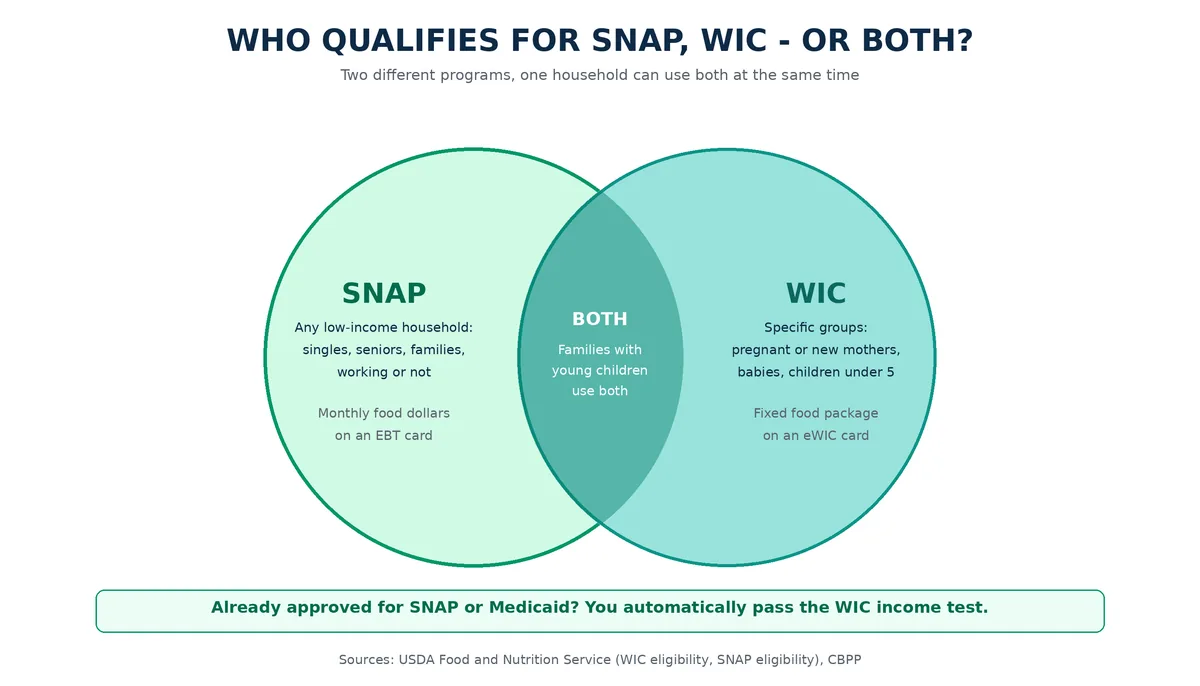
WIC benefits also never reduce your SNAP amount. Food packages count as in-kind nutrition help, not income, so the SNAP caseworker ignores them when budgeting your household. Families with young children who stack both programs routinely end up with an EBT card for groceries, an eWIC card for the baby's formula and cereal, and no offset between them.
💡 Practical tip: apply for SNAP first if you need both. It takes longer to process, and once approved, the WIC income test is automatic. WIC offices can often enroll you within days because the income check is already done.
How the 2026 Income Limits Compare
Which program is easier to qualify for? It depends on your household's shape. Here are the starting gross-income gates for 2026, side by side:
Household size | SNAP gross limit (130%) | SNAP gross limit (200% BBCE states) | WIC limit (185%) |
|---|---|---|---|
1 person | $1,696 | $2,610 | $2,461 |
2 people | $2,292 | $3,526 | $3,337 |
3 people | $2,888 | $4,442 | $4,212 |
4 people | $3,483 | $5,360 | $5,088 |
Three patterns jump out. First, WIC's 185% line sits between SNAP's standard 130% gate and the 200% gate that most states now use. Second, WIC's test is simpler — gross income against one number, no deductions, no net test. Third, a family can earn too much for SNAP in a strict state yet still clear WIC by a comfortable margin. A single mom earning $2,400 a month misses SNAP's $1,696 gross limit but passes WIC's $2,461 line for herself and her baby.
Alaska, Hawaii, Guam, and the U.S. Virgin Islands publish higher limits for both programs because of higher living costs. Your state's numbers live in our state-by-state SNAP guides.
What You Can Buy With Each Benefit
This is where the programs feel most different at the checkout line. SNAP buys almost any food: fruits, vegetables, meat, dairy, bread, snacks, seeds, even birthday cake from the grocery bakery. Alcohol, hot prepared foods, vitamins, and non-food items are the main exclusions.
WIC buys a defined package for each participant: milk, cheese, eggs, iron-fortified cereal, whole grains like bread and brown rice, peanut butter, beans, juice, canned fish for breastfeeding mothers, infant formula for babies who are not fully breastfed, and a monthly fruit-and-vegetable allowance. The cashier's eWIC terminal simply won't ring up anything outside the package — there is no partial eligibility for a box of cookies.
Families stacking both programs usually split the cart: WIC covers the staple nutrition package first, and SNAP dollars handle everything else in the basket. If your SNAP deposit timing matters for that trip, check the monthly EBT payment schedule so you know when funds land.
How Benefits Arrive: EBT vs eWIC
Both programs run on cards, but the mechanics differ. Your EBT card holds dollar amounts that load once a month and roll over if you don't spend them — a $459 deposit stays yours until you use it. The eWIC card holds specific food quantities — say, four gallons of milk and a dozen eggs — and each month's package expires on the schedule your state sets, so benefits need regular use rather than saving.
Card management differs too. SNAP has no work requirements for parents caring for children, and benefits continue as long as eligibility holds. WIC certification runs in fixed windows — often six months to a year — and ends when the child turns five or the postpartum period closes, at which point families transition off WIC and lean fully on SNAP.
Common Problems — and How to Handle Them
"My child just turned five." WIC eligibility ends at the fifth birthday, but the household usually stays SNAP-eligible — report the age-out at your next SNAP recertification rather than assuming benefits end. A family of four that loses one WIC participant may still see its SNAP amount hold steady or even shift with household composition.
"I make too much for SNAP." Check WIC before giving up — its 185% limit is simpler and higher than SNAP's 130% test in states that never adopted the 200% option. And in states that did, a family of four can gross up to $5,360 and still pursue SNAP. Curious how benefits grow at higher award levels? See how some Pennsylvania households reach $1,000 a month.
"I'm moving to another state." Both programs end and restart — WIC certifications and SNAP cases don't transfer across state lines, though WIC's nutrition assessment paperwork often carries over. Reapply promptly in the new state; SNAP processing still runs on the same 30-day clock everywhere.
⚠️ Don't skip WIC because of rumors. WIC is not part of the public-charge test — that test looks only at cash assistance and government-funded long-term institutional care, not food programs. If immigration concerns are holding you back, ask the WIC office directly rather than going without.
SNAP vs WIC FAQ
Can you be on SNAP and WIC at the same time?
Yes — and it is common. Enrollment in SNAP, Medicaid, or TANF makes a household automatically income-eligible for WIC, so most families with a new baby or a child under five qualify for both. The benefits stack without reducing each other.
Does WIC reduce my SNAP benefits?
No. WIC food packages are treated as nutrition assistance, not income, so the SNAP budget ignores them. Your SNAP amount is calculated from your household's own income and deductions exactly as it would be without WIC.
Does WIC have work requirements like SNAP?
No. WIC has no work or time-limit rules — eligibility depends on the life-stage category, income, and the nutrition assessment. SNAP's three-month time limit for able-bodied adults 18 to 64 simply does not exist on the WIC side.
Can fathers or grandparents apply for WIC?
Yes — a father, guardian, or foster caregiver can apply on behalf of an eligible infant or child in their care. The WIC category follows the child, not the applicant, so a single dad with a two-year-old absolutely can enroll that child.
What happens when my child turns five and ages out of WIC?
WIC stops at the fifth birthday, but SNAP continues independently — your household's SNAP case doesn't lose benefits because WIC ended. Many families recheck their SNAP amount at that point, since household composition changed, or explore school meal programs that begin at school age.