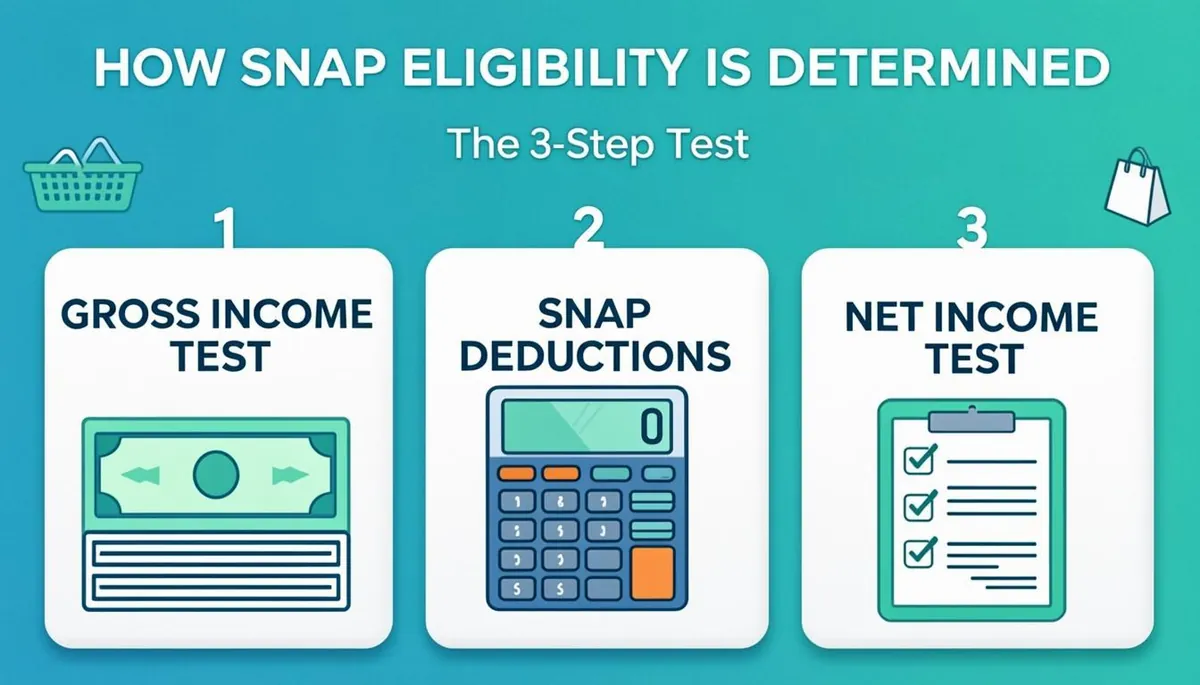
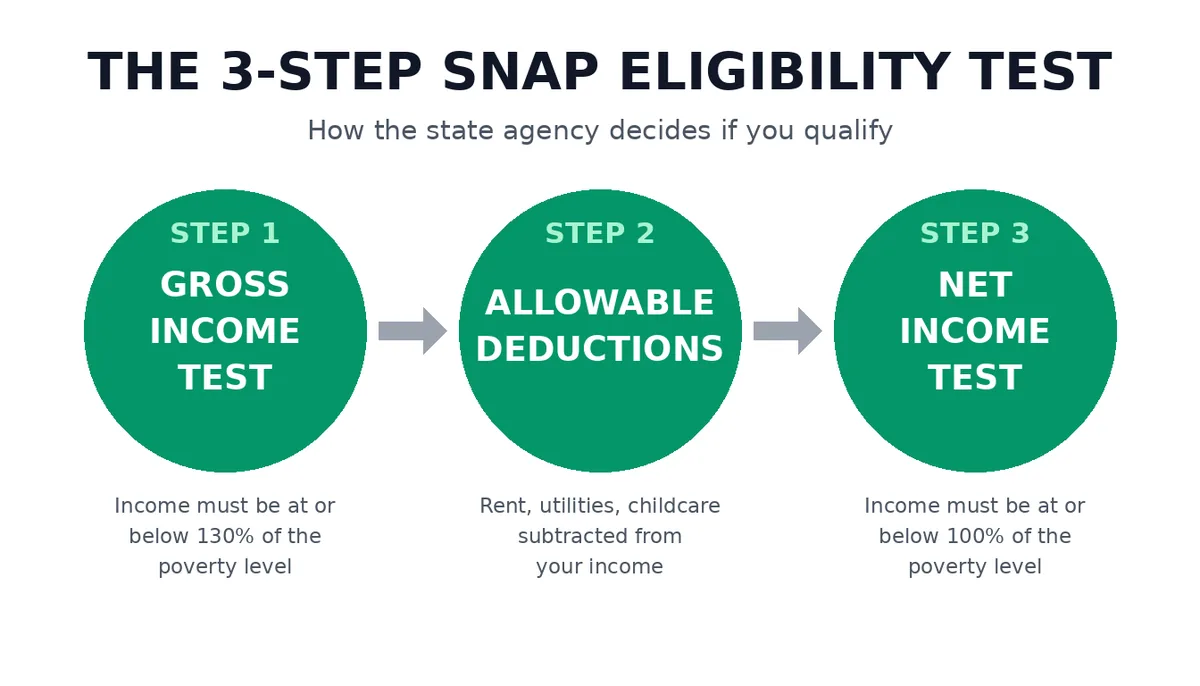
SNAP eligibility is determined through a three-part budget review that your state's SNAP agency runs on every application: a gross monthly income test, a round of SNAP deductions, and a net income test. A caseworker adds up your household's income, subtracts approved expenses, and compares the result against federal limits set by the USDA for fiscal year 2026.
Most applicants never see how this math works. You apply, complete an interview, hand over some documents — and weeks later a letter arrives with a yes, a no, or a benefit amount that seems to come out of nowhere. In reality the decision follows a strict, predictable sequence you can learn to predict yourself.
This guide walks through the entire determination process step by step: what happens after you apply, what the eligibility interview covers, which documents get verified, how the gross and net income tests work with FY2026 limits, and how your monthly benefit amount is calculated from there. Every figure below comes from the USDA's fiscal year 2026 standards, which run from October 1, 2025, through September 30, 2026.
If you would rather skip the math, our free food stamp calculator runs the same three-step test in about a minute using your own household numbers.
What Determines SNAP Eligibility? The Short Answer
Three things decide whether a household gets SNAP: how many people live and eat together, how much countable income comes in each month, and which deductible expenses it pays. Your state agency feeds those facts into a standard worksheet — and the worksheet, not the caseworker's opinion, produces the decision.
Federal rules set the income limits, deduction amounts, and benefit formula. States run the program and can loosen some rules through BBCE, a policy that raises the income ceiling in most states — which is why two identical families can get different answers in different states.
For the full list of who can qualify — citizenship, student, and work rules — see our guide on who qualifies for SNAP in 2026. This article is about the how: the process and math that turn an application into a decision.
The SNAP Determination Process, Step by Step
Every application moves through the same six stages, and knowing where your case sits tells you what to do next.
Application filed — you submit the form to your state agency, and a 30-day processing clock starts that day.
Eligibility interview — a caseworker calls (or meets) you to confirm your household situation, income, and expenses.
Verification — you provide documents: pay stubs, rent receipts, utility bills, identification.
Budget calculation — the caseworker builds your monthly SNAP budget from verified numbers.
The three tests — gross income, deductions, and net income are checked against the FY2026 limits.
Decision notice — an approval or denial letter arrives, and approved households get an EBT card and benefits.
Stages 4 and 5 cause the most confusion, so the math gets its own section below. First, the early stages.
Step 1: Your Application Starts a 30-Day Clock
The determination officially begins the day your state agency receives your application — not when it gets reviewed. Federal rules require a decision within 30 days of that date, which matters later too because benefits are paid retroactively to it.
Apply online, by mail, or in person — the application is always free, and most states process online applications fastest. Our state SNAP calculator list links to every state portal in one place.
Households with almost no income or resources can be flagged for expedited service at this stage. Expedited cases must receive benefits within 7 calendar days, before the full budget review is even finished.
Step 2: The Eligibility Interview
After your application is in, a caseworker conducts an eligibility interview — usually by phone, sometimes in person. The interview is a standard part of how SNAP eligibility is determined, and most states now require one. Oregon, for example, made interviews mandatory for every applying and renewing household starting June 1, 2026, as pandemic-era waivers ended (Oregon DHS announcement).
Expect questions in four areas: who lives and eats with you, how much each member earns, which monthly expenses you pay (rent, utilities, childcare, child support, medical costs), and identification details. Your answers are what the caseworker writes into the budget worksheet.
⚠️ The most common avoidable mistake
Missing the interview call. In most states, an unfinished interview means the application is denied — even if you clearly qualified. If you miss the call, reschedule immediately; most agencies offer same-week callback windows.
The interview is also your chance to mention expenses the form did not ask about. A $300 monthly childcare bill or heavy utility costs can change your result by hundreds of dollars, so speak up before the call ends.
Step 3: Verification — Documents That Prove Your Case
After the interview, the agency sends a verification list. Everything you stated gets checked against paperwork, and the clock keeps running while you gather it. Sending documents within a day or two is the fastest way to speed up your case.
Typical verification requests include:
Identity — driver's license, state ID, or passport for the head of household
Income — your last 30 days of pay stubs or an employer letter, plus benefit award letters
Housing — rent receipt or lease, recent mortgage statement
Utilities — electric, gas, or phone bills (states apply a standard utility allowance)
Dependent care — receipts or a signed statement from your childcare provider
Medical costs — pharmacy printouts and bills, if a member is 60+ or disabled
Self-employment — your most recent tax return or profit-and-loss record
Some items get verified electronically, but any missing document at decision time means a denial for "failure to verify" — fixable, yet it forces you to start over. Send everything before the deadline on your letter.
How the Caseworker Budgets Your Income
Once documents are in, the caseworker builds your SNAP budget — three tests, run in order. Fail the first and the case ends there; pass all three and the same worksheet sets your dollar amount.
Test 1: The Gross Monthly Income Test (130% of Poverty)
Gross income means everything your household receives monthly before deductions: pre-tax wages, self-employment income after business expenses, Social Security, unemployment, and child support received. For most households it must be at or below 130% of the federal poverty level.
Household Size | Gross Income Limit | BBCE Gross Limit |
|---|---|---|
1 person | $1,696 | $2,610 |
2 persons | $2,288 | $3,526 |
3 persons | $2,888 | $4,442 |
4 persons | $3,483 | $5,360 |
5 persons | $4,079 | $6,278 |
6 persons | $4,674 | $7,196 |
Source: USDA FNS FY2026 income eligibility standards (effective Oct 1, 2025 – Sep 30, 2026). Add $596 to the gross limit or $918 to the BBCE limit for each additional member.
Two groups get relief here. Households with a member who is 60+ or disabled are exempt from the gross limit entirely, and most states use BBCE, which lifts the ceiling to the 200% column — often the difference between qualifying and denial for working families. State rules vary, so check a local guide such as our Florida SNAP income limits breakdown.
Test 2: SNAP Deductions Turn Gross Into Net
Passing the gross test is only halfway. The caseworker now subtracts approved expenses, in a fixed order, to reach net income. Every SNAP budget allows these deductions:
20% earned income deduction — one-fifth of your wages comes off automatically. Earn $2,700 and $540 is subtracted first.
Standard deduction — $204 per month for households of one to three people in FY2026, slightly higher for larger households.
Dependent care — childcare or adult care costs that let you work, look for work, or attend training or school.
Child support paid — court-ordered payments you make to someone outside the household.
Medical expenses over $35 — out-of-pocket costs above $35 per month, allowed only when a member is 60+ or disabled.
Excess shelter costs — rent, mortgage, taxes, insurance, and utility allowances that exceed half of your adjusted income. The FY2026 cap is $744 per month, uncapped when a member is elderly or disabled. Homeless households get a flat $198.99 shelter deduction with no receipts required.
The shelter deduction does the heavy lifting for high-rent households. Take your income after deductions 1 through 5, divide by two, and shelter costs above that figure become deductible — up to the $744 cap. A family paying $1,400 in rent and utilities will almost always hit it, which is why reporting full housing costs matters so much.
Test 3: The Net Income Test (100% of Poverty)
After all deductions, what remains is countable net income, and it must be at or below 100% of the federal poverty level. For FY2026 that ceiling is $1,305 monthly for one person and $2,680 for a household of four, and most states apply it to every household, including BBCE ones.
The two-layer structure is deliberate: the gross test screens out high earners, while the net test measures actual need. High rent or childcare costs can push a family's net income down even when gross income looks comfortable.
How Your Benefit Amount Is Calculated
Approval is not the end of the worksheet. Your dollar amount starts with the maximum allotment for your household size — $298 for one person, $546 for two, $785 for three, $994 for four in FY2026 — minus 30% of net income, since households are expected to cover about a third of their own food costs.
One- and two-person households always receive at least the $24 minimum. Larger households can legitimately calculate down to $0 when net income is high enough. The full math, with more examples, lives in our guide to how SNAP benefit amounts are calculated.
Worked Example: A Family of Three Budget
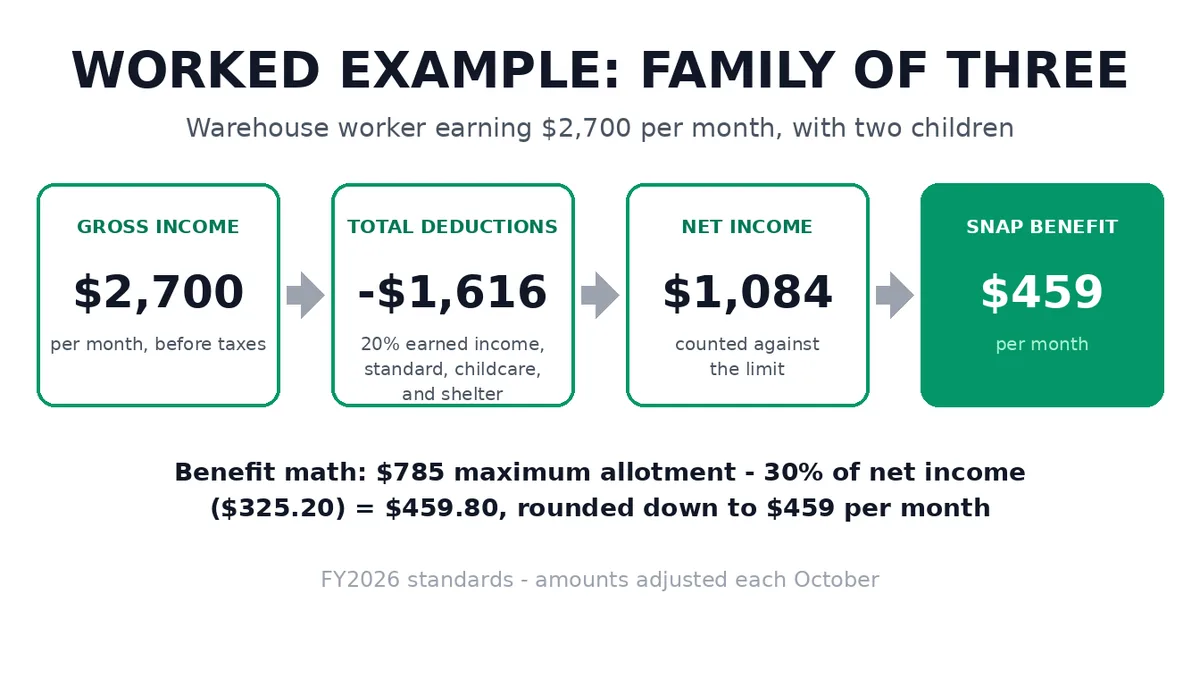
Here is the determination for Maria, a warehouse worker with two children. She earns $2,700 a month before taxes, pays $1,000 rent plus utilities, and spends $300 on childcare to keep working:
Budget Step | Amount | Running Total |
|---|---|---|
Gross earned income | +$2,700 | $2,700 |
20% earned income deduction | −$540 | $2,160 |
Standard deduction (3 persons) | −$204 | $1,956 |
Dependent care deduction | −$300 | $1,656 |
Shelter costs (rent + utility allowance) | $1,400 | half of adjusted income = $828 |
Excess shelter deduction ($1,400 − $828, under the $744 cap) | −$572 | $1,084 net income |
Now the tests: gross income of $2,700 sits below both the 130% limit for three people ($2,888) and the BBCE ceiling ($4,442), and net income of $1,084 is far below the $2,221 net limit. Maria is approved.
Her benefit follows the formula: $785 maximum allotment minus 30% of net income ($325) equals $459.80, which rounds down to $459 a month. A rent increase or childcare change reruns the same worksheet and moves the number.
✅ Key takeaway
Deductions decide outcomes. Maria's gross income was just $188 under the limit, but shelter and childcare costs pushed her net income far below the line — reporting every eligible expense routinely turns expected denials into approvals.
The Decision: Timelines, Notices, and EBT Cards
The standard window from application to decision is 30 days, and expedited households must be served within 7. The agency then mails a notice spelling out the outcome: approval or denial, your monthly amount, your certification period, and the reasoning behind the math. The federal standards for these steps are on the USDA's SNAP facts page.
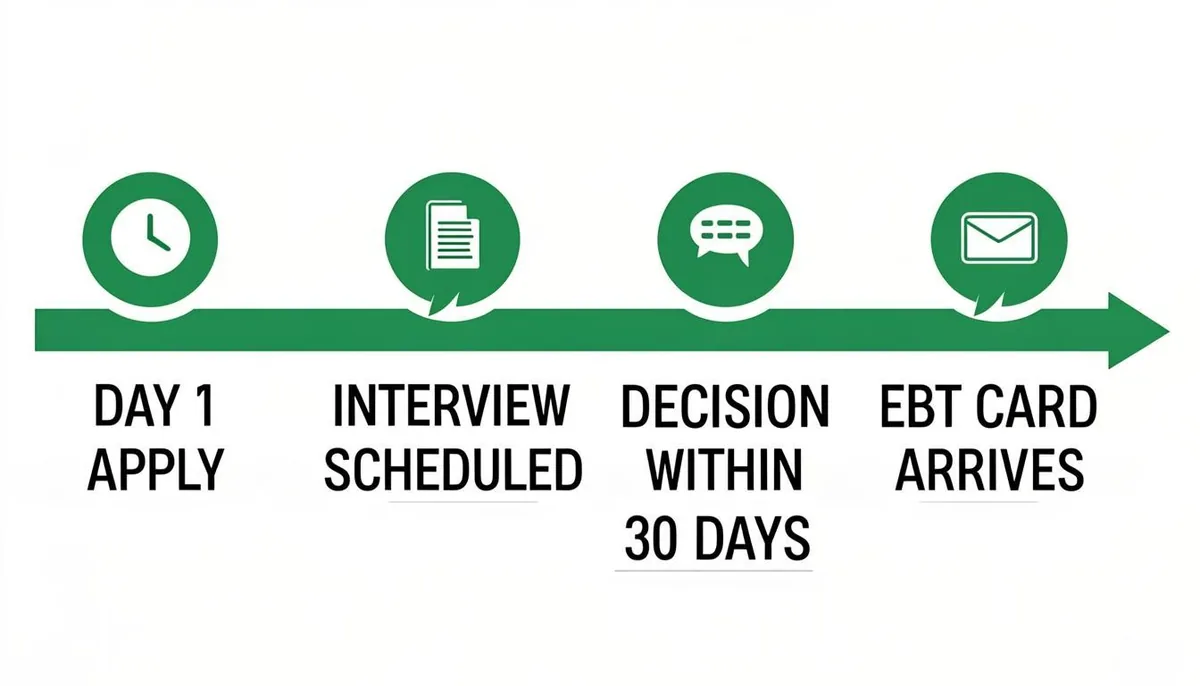
Approved benefits are retroactive to your application date, so nothing is lost while the case was pending. An EBT card arrives by mail within about a week, and benefits load on your state's assigned deposit day — the SNAP EBT payment schedule lists those dates.
Why SNAP Applications Get Denied
Most denials trace back to five fixable causes. Cross-check your case against this list before the 30 days run out:
Missed interview — the case is denied without one; call and reschedule immediately if it slipped.
Unverified documents — the deadline on the verification letter passed; send what you have and ask for an extension.
Gross income over the limit — in the few states without BBCE, earnings above 130% FPL end the case unless a member is elderly or disabled.
Student status — half-time+ college students must meet a work or exemption rule to qualify.
ABAWD time limit — adults 18–64 without dependents who do not meet the 80-hour monthly work rule can only receive 3 months in a 36-month period.
A denial letter must explain the reason and your appeal rights. You can request a fair hearing within 90 days, and in many states benefits continue while the appeal is pending. If your situation genuinely changed — a pay cut, a new baby, higher rent — reapplying is often simpler than appealing.
Related SNAP Guides
If you are working through eligibility and benefit questions, these guides cover the next steps:
Food Stamp Calculator — run the same three-test worksheet on your own household numbers
Who Qualifies for SNAP — citizenship, student, and work requirement rules in one place
How Are Food Stamps Calculated — deeper examples of the benefit amount formula
Florida Food Stamp Calculator — state-level income limits and benefit estimates for Florida
SNAP EBT Payment Schedule — when approved benefits land on your card each month
All State SNAP Calculators — income limits and application links for all 50 states
Note: All limits, deductions, and allotments in this guide reflect USDA fiscal year 2026 standards (October 1, 2025 – September 30, 2026). New COLA-adjusted figures take effect October 1, 2026. For official verification, see the USDA FNS eligibility page or contact your state SNAP office.